Fr. Ed Namiotka
Pastor
The thoughts and writings of Fr. Ed Namiotka as taken from his weekly parish bulletin columns.
Dear Parishioners,
Guten morgen! Or, as they
say in Bavaria: Grüß Gott (a form of “God
bless you”).
Maybe some of you will recall the
movie from 1969 about a bunch of American tourists in Europe entitled “If It’s Tuesday, This Must Be Belgium.” I’m going to have
to watch it again. I understand there is
a sequel. I don’t need to watch the
second film. We just experienced it on
our own.
Last night I slept in my own bed
at the rectory. I was exhausted after
being up from about 5 AM (Central European time) in Munich. The flight home from Germany to Philadelphia was
rather uneventful and it arrived on time. Getting through customs was another story. I don’t want to throw anybody under the bus,
but, as a friendly reminder, don’t try to bring the uneaten fresh fruit (apples,
pears) that you were served for breakfast back into the country. It can cause certain “problems” with U.S. Customs and Border Protection.
Continuing
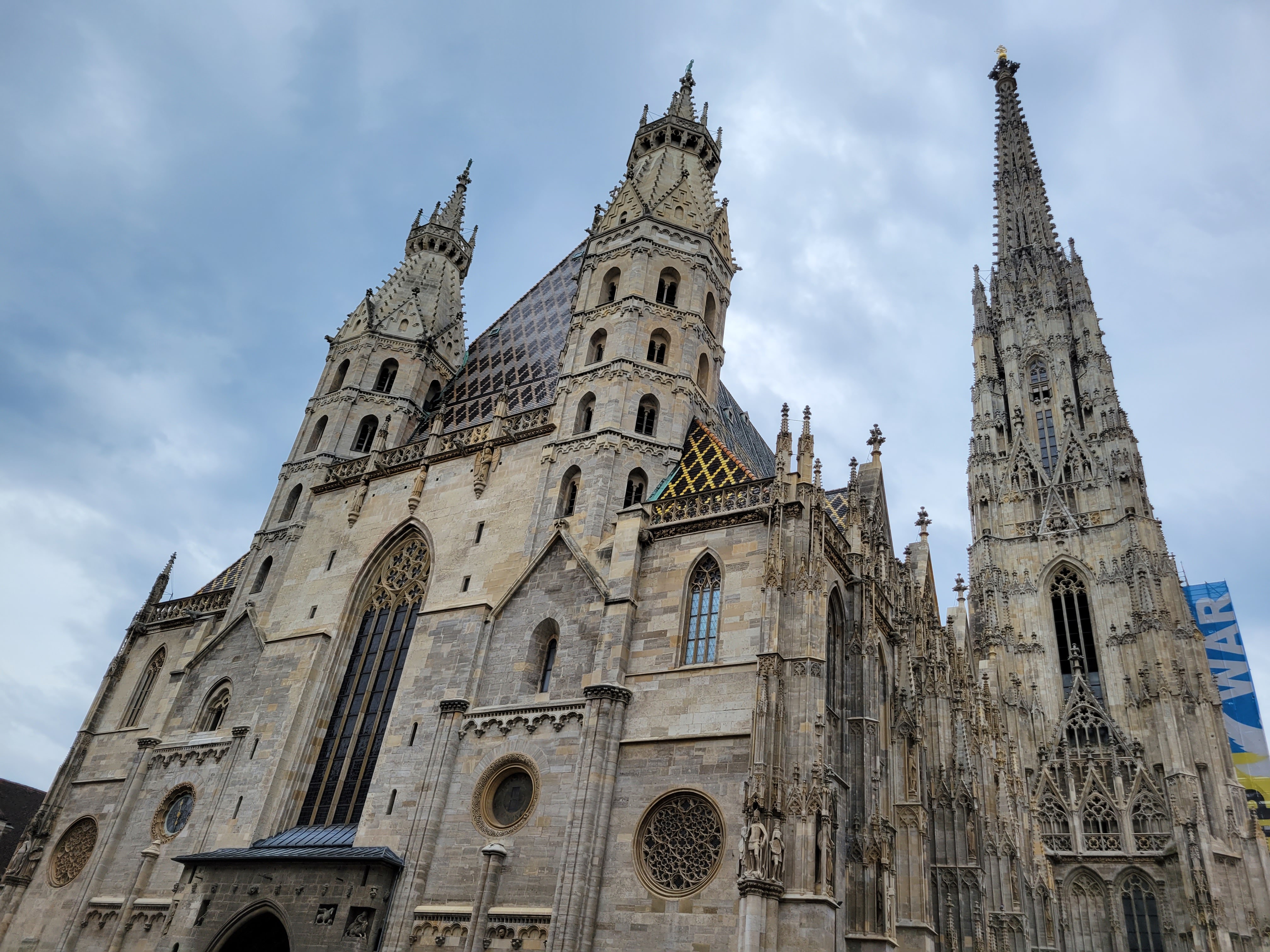
with my report of the pilgrimage (saga) from last week, we spent only a few hours in Bratislava (Slovakia) and then two days in Vienna (Austria). Vienna's highlights included seeing its cathedral (St. Stephan) and attending an orchestra concert. Later, we visited Altötting
(Bavaria) where there is the famous statue (Black Madonna) of Our Lady of Altötting and a Capuchin
Franciscan friary housing the relics of St. Conrad of Parzham, O.F.M. Cap. Both
of these are worth investigating.
Pope Benedict XVI has great
devotion to Our Lady of Altötting and
even gifted his episcopal ring to her from his time as Archbishop of Munich. The
ring was then placed on the statue itself.
St. Conrad of Parzham had a
story similar to St André Bessette in
our part of the world (Montreal). Both were
humble porters (doorkeepers) who became saints.
Our pilgrims later attended the
famous Passion Play in Oberammergau
(Bavaria). The play which is performed in
a covered, open-air theater takes around six hours to complete. All of the many participants are from the
village. There is a magnificent, large choir
and an orchestra. Naturally, the
dialogue and songs are completely in German, but we were given a book with
the complete translation into English. Because
of its great length, we were allotted time at the intermission to have a meal
in a local restaurant.
The Passion Play is an event I had heard about in my youth but never
realized I would eventually experience for myself. The
play was not a performance but a faith-filled event to be experienced. The current interpretation showed how the Old
Testament (Hebrew Scriptures) were fulfilled in the life of Jesus. There was some obvious artistic creativity
and poetic license employed during the performance. I was disappointed,
however, by the portrayal of the Last
Supper as it omitted the most important words of consecration spoken by Jesus (“This is My Body. . . This is My Blood”). Perhaps, it may be just another indication
of how many people do not truly grasp the Real
Presence of Jesus in the Most Holy
Eucharist.
Finally, it was on to the city of
Munich with its famous Glockenspiel (clock)
and many biergartens. Fortunately, we just avoided the crowds of the Oktoberfest.
While we didn’t lose anyone permanently during the trip, there were a few moments of separation-anxiety. Some items (backpacks, passports) were lost but then found. The tour bus, unfortunately, took off with my cell phone. I don’t know what it wanted with my phone. Thanks to modern technology, I was able to track the phone on my computer and it was returned the next day. (You didn’t actually think that I was going to blame myself for this mishap, did you?)
I am certainly glad to be home!
Fr. Ed Namiotka
Pastor
Danube River, (Budapest, Hungary)
Dear Parishioners,
I am writing to you from Budapest, Hungary after having finished a brief one-hour river cruise on the Danube. The group I am with consists of thirty-one pilgrims, twenty from the east coast (New Jersey, New York and Pennsylvania) and eleven from the west coast (Los Angeles area). Ultimately, we will wind up in Oberammergau to see the world famous Passion Play. Additionally, we visit Prague, (Czech Republic), Bratislava (Slovakia), Budapest (Hungary), Vienna (Austria) and Munich (Germany).
Needless to say, the days contain much activity. Every day there is a bus ride, sometimes for hours. Often there is a rather tight schedule, usually including Holy Mass in a local church. We tour the various cities. We unpack and pack as we move from hotel to hotel. We eat, sleep and drink. And we get tired.
The difficult task of the pilgrimage leader (me) is to keep the pilgrims on time and together. There are those who want to shop. There are those who need to use a bathroom. Some stop to take pictures. Some have difficulty walking and cannot navigate the cobblestone streets or the non-handicapped accessible stairs of old Europe. Some go off on their own and get separated from the group. Some barely make it across the street as the trolley-car rapidly approaches them. There is no better way to describe my task than like attempting to herd a bunch of stray cats. Jesus sometimes used the comparison of a shepherd with the flock. Either image suffices. Sheep may be somewhat easier to handle.
Some highlights for me of our trip (so far) included visiting the church and offering Mass where the famous statue of the Infant of Prague is housed, seeing the tomb of St. Adalbert (patron of the Polish church in Philadelphia where my parents were married) and offering Mass in Budapest where a portrait of Our Lady of Czestochowa was the centerpiece of the high altar of a beautiful baroque church just steps from our hotel.
Much more is planned for the days ahead and it will certainly take me some time to process all that I have and will experience. This trip was postponed for two years because of a certain pandemic. However, the situation in this part of the world seems to have returned to "normal." Tourists abound and there is no sign of the former restrictions on society for health reasons.
While I like to travel, I miss my parishioners and my parish. Some parishioners, however, are with me now. I will do my best not to lose any.
When I get back, there will be stories to tell, pictures to show and work with which to catch up. However, I intend to enjoy the current surroundings and to spend time observing the various cultures.
In the meantime, it is almost dinner time (six hour time difference) and I need to check up on the rest of the bunch. Maybe I will get lucky and they all will be there and on time!
Please pray for me/us.
Fr Ed Namiotka
Pastor

Dear Parishioners,
I question how many people know
what it actually says in our liturgical books (the Roman Missal) about the sign
of peace. I quote from the rubrics (liturgical
instructions printed in red): Then,
if appropriate, the deacon or priest adds: “Let us offer each other the sign of
peace.” It appears to be left to the
priest’s discretion whether or not he invites people to exchange the sign of peace at Mass.
There are numerous options given
to a priest during Mass. There is the choice of penitential rite, the choice of Eucharistic
Prayer and the choice of final blessing,
just to name a few. A priest may wear
Gothic or Roman vestments. A priest may incorporate Latin (Sanctus, Agnus Dei) and
Greek (Kyrie) into the Mass. A priest can decide whether to offer Mass
using the prayers for the saint of the day (when it is an optional memorial) or not. (Then, the liturgical colors of the
vestments would sometimes change accordingly.)
A priest may choose to use incense at Mass. Etc.,
etc., etc. Lots of options are
given. Perhaps too many.
What’s my point?
With so many options at the
discretion of the priest-celebrant, the Mass can look quite different from parish to parish, let alone from diocese
to diocese or country to country. (And, I am not speaking about
language/cultural differences here.) The
Mass—which was once a unifying point for Catholics throughout the world—has, at many
times, become a place of confusion and sometime outright contention. I don’t
like that type of music. Why do you have
to use Latin? Incense makes me
cough. There should be more time for
silence. We should/should not use
bells. Get the picture?
The current trends coming from
authorities in Rome seem to have a real problem with traditional forms of the Mass.
As one who has seen liturgical abuses ad nauseam over my fifty plus years serving on the altar (altar
boy, seminarian, through 35 years of priesthood), it completely baffles
me. So many things I have seen have
truly been scandalous and irreverent—from Masses celebrated on a raft in the
ocean by a bare-chested priest, to clown
Masses, to rock and roll Masses, to Masses
with puppets, to Masses with liturgical dance by scantily-clad women,
etc. etc. And the traditional Latin Mass
is discouraged, limited, forbidden or condemned? Give me
a break!
Up until the 1960’s, there was a traditional, standard, unified way of offering the Holy Sacrifice of the Mass. Somehow, afterwards, it became acceptable and standard practice for the priest to no longer face God (ad orientem), for the people to receive Holy Communion in the hand without kneeling in reverence, to flood the sanctuaries with Extraordinary Ministers of Holy Communion (commonly referred to as Eucharistic Ministers), and many other practices. Has it all led us to a deeper belief in the Real Presence of Jesus in the Holy Eucharist? Have the churches grown or diminished in membership? Are there more young men desiring to be priests? Do the majority of baptized Catholics still believe and regularly practice their faith?
But when the Son of Man comes, will he find faith on earth? (Lk. 18:8)
So, when it comes to offering the
sign of peace at Mass, don’t be surprised if I choose not to exercise my option here. Maybe, then, there may be some realization
that too many liturgical options can
and have
led to too many liturgical abuses.
Fr. Ed Namiotka
Pastor