Sunday, August 30, 2026

Tuesday, August 25, 2026
Reflecting on the Cross

Dear
Parishioners,
You
will find that I refer to the cross
of Jesus quite frequently when I preach. Maybe I have been profoundly influenced by St. Paul: I
preach Christ Jesus and Him crucified. (See 1 Cor. 2:2 and 1 Cor.
1:23)
Typically, I will point to the image of the crucified Jesus. While some churches have an image of the resurrected
Jesus in the sanctuary, as did one of my former parishes, I really must confess that I am not quite there yet
in my own spiritual life. I relate
better to the crucified Jesus who
truly knew suffering and experienced death. Intellectually, I know that JESUS
IS RISEN, and I certainly preach Him as risen from the dead. However, whether it be in my personal chapel
in the rectory, or in the church itself, I look to the crucified Jesus—to the crucifix—more often than not.
Each
day I see suffering in the world. When I turn
on the evening news, read the newspaper or find an article on the internet, so many of the stories involve tragedy: a plane going down, a hurricane, a wild fire,
a flood, war, violence, murder, etc. I
see people suffering and dying. I visit
the hospital and I find someone extremely sick with family members surrounding him or her in tears. I visit the
homebound. I celebrate a funeral
Mass. Get the picture?
Jesus
knew suffering. Meditating on the
sorrowful mysteries of the Holy Rosary, making the Stations of the Cross,
reading an account of Jesus’ passion in the Sacred Scriptures, looking at a crucifix, all tell me that
Christ can relate to the pain and suffering of humanity.
I ponder the image of the Risen Christ and truly hope to be there someday. I also realize that resurrection and
eternal life are still somewhere—with God’s grace and through His forgiveness,
mercy and love—in the future for me.
However,
I continue look at the crucifix. Maybe I do not receive immediate answers to all my
prayers. Maybe I still have questions
and doubts. But what I see is a God who
loved me enough to suffer and to die for me. I see Jesus who willingly accepted suffering and experienced it to the
depth of his being. I see a humble,
vulnerable God who took upon Himself all of our sins—my sins. I see Jesus who died for me, for all of us.
At
this point in time, you can see where I am in my personal spiritual life. I see myself at the foot of the cross. I hope someday for resurrection and eternal
life. But I am, unfortunately, just not
there yet.
. . . Whoever wishes to come after me must deny himself, take up his cross, and follow me. For
whoever wishes to save his life will lose it, but whoever loses his life for my sake will find it. (Mt. 16: 24-25)
Fr. Ed Namiotka
Pastor
Tuesday, August 18, 2026
Why Catholics Continue to Have Hope

Dear Parishioners,
As a Catholic priest I am
charged with preaching the Gospel—the Good News. I can certainly point out all of the things
that are confusing or even scandalous in the Catholic Church. However, there are important reasons why true
Catholics do not give up hope despite the many obstacles we face. We do not flee when the wolf attacks the
sheep. We do not deny Jesus Christ as our Lord and Savior. We remain faithful even if everyone calls us ridiculous,
stupid, or out of touch. Remember in the Beatitudes
we are told that we are actually blessed when we are unjustly persecuted.
Blessed are you when they insult you and persecute you and utter every kind of evil against you [falsely] because of me. Rejoice and be glad, for your reward will be great in heaven. Thus they persecuted the prophets who were before you. (Mt. 5: 11-12)
Opposition and persecution have
been present from the beginning of the Church and continue to this day.
Let me reflect with you on
some of my reasons for ongoing hope within the Catholic Church:
- Jesus is victorious over sin and death. Jesus’ suffering and death on the cross, rather than being a defeat, was a victory. Jesus rose from the dead. Death has no more power over Him. His Resurrection gives every Christian the hope of eternal life. While we have not yet seen the culmination of all God’s plans, we know Who has already won the victory. Christus Vincit!
- Jesus promised to remain with His Church. “And behold, I am with you always, until the end of the age.” (Mt. 28:20) First, Jesus remains with us in the Holy Eucharist. We believe in His Real Presence on our altars and in our tabernacles. We also have the Sacred Scriptures to guide and inspire us. Through the ministerial priesthood Christ still acts in each sacrament. Christ remains with His Church whenever we gather in His name, but most especially at the Holy Sacrifice of the Mass.
- Jesus told us that evil will not prevail. “And so I say to you, you are Peter, and upon this rock I will build my church, and the gates of the netherworld shall not prevail against it.” (Mt. 16:18) Through the centuries, there have been bitter battles for the soul of the Church. We have seen many martyrs. We have had bad popes, bishops, priests, etc. Attempts have been made to destroy the Church from within and from without. Despite all such attempts, the Church remains. And it will remain.
- Our Lady continues to intercede for us, her children. Devotion to Our Blessed Mother is a sine qua non for any believing Catholic. I have been especially devoted to the apparitions of Fatima (Portugal) and to the other approved apparitions like Lourdes (France), Guadalupe (Mexico), etc. According to the seer Sr. Lucia, the message given at Fatima from Our Lady was ”In the end my Immaculate Heart will triumph.” When we pray the Hail Mary, we ask for Our Lady’s intercession now and at the hour of our death. She was given to us at the foot of the cross to be our spiritual mother. She continues to intercede for her children and to care about their eternal salvation as any good mother would.
I continue to have hope. What is going on in the Church and the world still concerns
me tremendously. Yet, we need to remain
faithful to the Lord as He is always faithful to us.
If you have any doubts, look at the crucifix.
Fr. Ed Namiotka
Pastor

Sunday, August 16, 2026
Wednesday, August 12, 2026
The Pastoral (Parish) Council
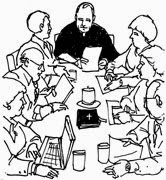
Dear Parishioners,
When we examine what canon
(church) law requires of every parish, we see that a finance council is mandated.
Canon 537 states: In each parish there is to be a finance
council which is governed, in addition to universal law, by norms issued by the
diocesan bishop and in which the Christian faithful, selected according to
these same norms, are to assist the pastor in the administration of the goods
of the parish . . . . This council
is established and active here at St. Thomas the Apostle Parish and meets regularly attempting to keep
our parish operating in a fiscally responsible manner.
Canon law also states the following (Canon 536): 1. If the
diocesan bishop judges it opportune after he has heard the presbyteral council,
a pastoral council is to be established in each parish, over which the pastor
presides and in which the Christian faithful, together with those who share in
pastoral care by virtue of their office in the parish, assist in fostering
pastoral activity. 2. A pastoral council possesses a consultative
vote only and is governed by the norms established by the diocesan bishop.
Regarding this pastoral council, I wish to re-establish it anew in the fall. I am looking for a select group of people (9
to 12 are recommended) to help advise me with various matters
concerning the future of the parish.
According to our diocesan guidelines: Parish Pastoral Councils provide a way for pastors to consult their people. The Parish Pastoral Council is: "to examine and consider all that relates to pastoral work and to offer practical conclusions on these matters, so that the life and activity of the People of God may be brought into greater conformity with the Gospel." In this description, we find three tasks assigned to the pastoral council: to examine, to consider, and to recommend.
- To examine: The object of the Parish Pastoral Council's examination, "pastoral work," is left sufficiently un-specified in order to include all that concerns the pastor and his staff in serving the parish. The council identifies issues and studies them either at the request of the pastor or on its own initiative.
- To consider: The Parish Pastoral Council prayerfully ponders the data it has collected from its examination by trying to discern in what direction God is inviting the parish to go, what is behind the data.
- To recommend: After the Parish Pastoral Council has examined and considered any pastoral work, it makes a recommendation to the pastor and his staff on what should be done for this parish at this time in its history.
I am looking for
dedicated, prayerful people willing to help me. If you are
interested or you wish to recommend someone for this task,
please let me know in writing or by e-mail by September 30,
2026. (My parish email is Fr.Namiotka@stabrig.org)
After prayerful consideration, the council will be re-established anew to assist me with the future vision and direction of St. Thomas the Apostle Parish. For those who want more information, the diocesan Parish Pastoral Councils Guidelines in English and Spanish can be found on the diocesan website.
Please give my request some prayerful deliberation. More information will follow in the months ahead.
Fr. Ed Namiotka
Pastor
Sunday, August 9, 2026
Wednesday, August 5, 2026
The Assumption and the "Wedding of the Sea"

Dear Parishioners,
There is a Holy Day coming
up next week: the Assumption of the Blessed Virgin Mary into Heaven. This year,
because of the way it falls on the calendar on a Saturday, the obligation to
attend Mass is removed. However, it does not mean that it is any less holy of a day.
The Assumption celebrates
the Blessed Virgin Mary, after her earthly life was complete, being
taken up body and soul into Heaven. According to the Catechism of the Catholic Church (CCC):
“Finally the Immaculate Virgin,
preserved free from all stain of original sin, when the course of her earthly
life was finished, was taken up body and soul into heavenly glory, and exalted
by the Lord as Queen over all things, so that she might be the more fully
conformed to her Son, the Lord of lords and conqueror of sin and death.” The
Assumption of the Blessed Virgin is a singular participation in her Son's
Resurrection and an anticipation of the resurrection of other Christians. . . .
(CCC, #966)
Growing up in Wildwood, NJ leaves me with many fond memories. One of these was
the celebration of the vigil of the Assumption at St. Ann’s Church each
August 14th. When I was young, the Vigil Mass was usually packed (standing
room only). St. Ann’s could hold approximately 3000 people and I can
recall seeing it year after year wall to wall with
people. Unlike the famous celebration in Atlantic City which takes place during the day on August 15th,
the Wildwood tradition was/is a vigil Mass followed by procession down to the
beach for the Wedding of the Sea ceremony. Most years, the
bishop would preside during this ceremony in both locations.
At many seashore towns, the Assumption
has become somehow tied into the Wedding of the Sea ceremony
which had an entirely different history and origin. Apparently the
custom found its way here from a couple of Venetian historical commemorations
and a ceremony in which the Doge (chief magistrate) of Venice
would "marry" the sea each year, and throw a blessed ring into the
lagoon as a sign of eternal fidelity. (Interestingly, the original
Venetian ceremony apparently took place in conjunction with the celebration of
the Ascension of Our Lord rather than the Assumption).
The Press of
Atlantic City reported a variation of the origin of the custom:
According to tradition, the ceremony
commemorates an event in the life of the Bishop of Cervia in Italy, Paul Barbo who
later became Pope Paul II. The Bishop is said to have been returning by
ship from Venice on the Feast of the Assumption in 1445 when he was caught in a
storm. The Bishop, it is said, calmed the storm by prayer and throwing his
pastoral ring into the sea. (6/16/10)
Here at St. Thomas the Apostle we will process to the ocean after
the 6:30 PM Mass on Friday, August 14th, the
vigil of the Assumption. I hope that you will join us in the public profession
of our Catholic faith.
Throughout history, it was not unusual that Christians would attempt to “Christianize” various secular customs and traditions. No matter what the exact origin of the Wedding of the Sea is, as we celebrate the Assumption of the Blessed Virgin Mary into Heaven, it is more important to recall the honored place that Mary, the Mother of God, has in salvation history and that her life on earth was worthy of an eternal reward in Heaven. Where Mary has gone, we hope to follow!
Holy Mary, Mother of God, pray for us!
Fr. Ed Namiotka
Pastor

Venice
Saturday, August 1, 2026
Subscribe to:
Posts (Atom)