Showing posts with label Baptism. Show all posts

Monday, March 2, 2026

Lessons from the "Woman at the Well"


Dear Parishioners,

In this Sunday’s Gospel for the 3rd Sunday of Lent "A", we have the story of the Samaritan woman at the well (Jn. 4: 5-42). Certainly, there are multiple lessons to be learned from this passage. I focus here on three.

Living Water. Jesus is thirsty and asks the woman for a drink. Their conversation then progresses to Jesus inviting the woman to ask Him for living water instead. As is typical in St. John’s gospel, there are varying levels of understanding present in the dialogue (see also the conversation with Nicodemus, Jn. 3: 1-21). The woman is thinking about water to quench thirst while Jesus is offering something more. Ultimately, I suggest Jesus is inviting us (through her) to BAPTISM. Jesus is the source or fountain of living water (grace, the Holy Spirit) which we initially receive through the sacrament of baptism. This is certainly an appropriate reflection for those throughout the world preparing for baptism through the Order of Christian Initiation of Adults (OCIA).

It is no secret that I am very frustrated when people do not see an urgency to get baptized themselves or to have their children baptized. According to the Code of Canon Law: Parents are obliged to take care that infants are baptized in the first few weeks (canon 867). Instead they wait years or decide to let the children “choose for themselves” when they get older. When baptism is delayed, sanctifying grace (God’s life) is not present in a person’s life. Remember, we are not born in a relationship with God, but rather separated because of original sin. Baptism washes away original sin (and actual sin, if one has reached the age of reason), makes one an adopted child of God and allows sanctifying grace to enter a person’s life. Do I not want this for myself and/or my children? Is there no sense of urgency?

I Do Not Have a Husband. While the woman denies that she has a husband, Jesus reminds her she has had five. As one of my seminary professors once put it: “She was the Elizabeth Taylor of her time.” This part of the dialogue reminded me about the importance of Catholics rectifying any marriage situation that is not seen as valid in the eyes of the Church. People in our congregation are sometimes married, divorced and then remarried outside the Catholic Church. Or they were never married in the Catholic Church in the first place. Unless the proper permissions were sought out and granted, these marriages may be invalid according to Church law. The longstanding Catholic teaching is that one should not receive Holy Communion, (or be a godparent or sponsor, or be an Extraordinary Minister of Holy Communion, etc.), until such a situation is rectified. An annulment (declaration of nullity) may be needed. Or a convalidation of the marriage may be necessary. Or the couple may be required to live in a brother/sister relationship, if nothing else can be done. It is best to set up an appointment with a priest to help discern what may be possible or necessary.

I am He, the One Speaking with You. As their dialogue continues, Jesus reveals his identity as the long-expected messiah. It is of utmost importance that we all realize the implications of this reality. Jesus is the messiah. He is also God’s only-begotten Son. Salvation comes through Him and on His terms, not ours. I am the way and the truth and the life. No one comes to the Father except through me (Jn. 14: 6). The Samaritan woman believed in Him. She also witnessed to others about Jesus. She led others to believe in Jesus. Similarly, if we acknowledge Jesus as our Lord, God, and Savior, then we must also bring others to Him. Go and make disciples (Mt. 28: 19). Start in your family. Witness to your friends. Tell the whole world what God has done for you!

Jesus continually uses unlikely people to be His disciples and his missionaries: fishermen, tax collectors, Samaritan women, you and me.
 
Let’s not waste any more time getting started or continuing to make excuses!

Fr. Ed Namiotka
Pastor

Tuesday, January 6, 2026

Baptism of the Lord


Dear Parishioners,

If the Lord Jesus was without sin, why would He ever need to be baptized by John the Baptist?

The most direct answer to this question is that Jesus did not need to be baptized.  So then, why did it happen?  Let’s first look at what the Catechism of the Catholic Church says on the topic:

Our Lord voluntarily submitted himself to the baptism of St. John, intended for sinners, in order to "fulfill all righteousness." Jesus' gesture is a manifestation of his self-emptying.  The Spirit who had hovered over the waters of the first creation descended then on the Christ as a prelude of the new creation, and the Father revealed Jesus as his "beloved Son." Catechism of the Catholic Church#1224
One way to think of Jesus’ baptism was that it is an anticipation of what He would do for us later on the cross. He would take upon Himself our sinfulness. Just as He did not die on the cross for His own sin, He did not receive the baptism of John to repent for His own sinfulness. We might rather say that Jesus made holy the waters of baptism by His own baptism. In addition, His Baptism in the Jordan River, like His Epiphany as a child to the magi, was another divine manifestation of Jesus’ true identity: “This is my beloved Son, with whom I am well pleased.” (Mt. 3:17)

Jesus’ Baptism should make us think about our own baptism.  St. Paul’s words to the Romans are instructive:

Do you not know that all of us who have been baptized into Christ Jesus were baptized into his death? We were buried therefore with him by baptism into death, so that as Christ was raised from the dead by the glory of the Father, we too might walk in newness of life.  (Rom. 6:3-4)
Baptism gives us new life—eternal life.  Baptism forgives our sinfulness—both original sin and any personal sin (once a person has reached the age of reason and is no longer an infant). With baptism we are adopted by God through Christ as His children. We become temples of God’s Holy Spirit dwelling within us. God’s own life now dwells in us—the life of sanctifying grace. We become a member of the mystical Body of Christ, the Church, and the doorway is now open for us to receive the other sacraments of the Church. All of these wonderful things and many other blessings (see the Catechism of the Catholic Church #1262ff.) occur with the simple pouring of water (or an immersion into it) combined with the baptismal formula: N., I baptize you in the name of the Father, and of the Son, and of the Holy Spirit.

Catholics should be aware that in the case of an emergency or danger of death any person can baptize. The Church primarily wants the salvation of souls and provides such an opportunity so no one would be lost!
 
Every time you bless yourself with holy water, remember that this sacramental is a reminder of your baptism into Christ Jesus who suffered and died for your salvation.  

I remind you to keep some blessed holy water in your homes.

Fr. Ed Namiotka
Pastor     


Tuesday, January 7, 2025

Reflecting on Our Baptism


Dear Parishioners,

There are times when we are reminded that we are baptized Christians. Whenever we walk into a Catholic Church and bless ourselves with holy water, we should recall that we are baptized. On Easter Sunday, the priest will ask that we renew our baptismal promises (in place of reciting the Nicene Creed) and will go up and down the church sprinkling us with the newly blessed Easter water. As an option for the penitential rite at Sunday Mass, the priest may also sprinkle us with the holy water recalling our baptism. Additionally, the Baptism of the Lord provides an opportunity for us to reflect on our own baptism.

Baptism makes us a Christian. We are not born in union with God but alienated from Him because of original sin. While we did not commit this sin, all humanity was wounded or stained by the disobedience of the first humans. (See Romans 5:12-21) We are not born into Grace (God’s life) but receive this life through our baptism. By baptism we are cleansed from original sin (and any personal sin if we are old enough to know and commit sin). We become adopted children of God though Christ. The Holy Spirit now dwells in us. We die with Christ in baptism so as to one day share eternal life with Him. We are welcomed into the Catholic Church and become a member awaiting full initiation (which comes with First Holy Communion and Confirmation). We need to reflect often on what baptism has done for and to us.

We remain in God’s grace unless we sin mortally. The concept of serious or mortal sin tells us that a particular sin (a willing, thought-out choice that we make involving a grave or serious matter) can once again alienate us from God’s grace. Apart from original sin which we inherit, we choose to sin. Fortunately, it is the Sacrament of Penance and Reconciliation (confession) that once again restores our baptismal graces and reconciles us with God and the Church. I tell people that every confession is a new beginning for us and we become a new creation because of God’s abundant mercy.

The Church still advocates infant baptism. I recall how it was important for so many in past generations to take seriously the teaching of the Church that infants be baptized in the first weeks following birth. As the Catechism of the Catholic Church states: “The Church and the parents would deny a child the priceless grace of becoming a child of God were they not to confer Baptism shortly after birth.”(#1250) The gift of Faith is so precious that I personally cannot understand how someone would knowingly deny or unnecessarily prolong his or her child from receiving baptism.

Baptism is one of those sacraments that is never repeated—once baptized, always baptized. It imparts a permanent character on us that is not removed—even by sin. Sin, however, can prevent baptism from bearing the fruits of salvation. Hence, there is a need and an obligation to be reconciled of any post-baptismal sin (especially mortal sin) by means of the Sacrament of Penance and Reconciliation.

So I ask that you think about your own baptism and all of its implications. Parents who have not yet presented your children for baptism are reminded to take this obligation very seriously. If you bring a child into this world, you are responsible for his or her upbringing, physical and material needs, love and emotional needs, as well as his or her eternal salvation. We are saved only through Christ Jesus. There is no other way to the Father except through Him. (See Jn. 14:6) Baptism is the way to eternal life because it is the means by which we allow Christ to be truly Lord of our life.

Fr. Ed Namiotka

Pastor


Tuesday, January 5, 2021

Some Thoughts About Baptism


Dear Parishioners,
We celebrate the feast of the Baptism of the Lord this Sunday (January 10, 2021).  Thankfully, there is an opportunity to preach and to reflect during the Sunday homily not only on Jesus’ Baptism but on our own individual baptism and its importance.

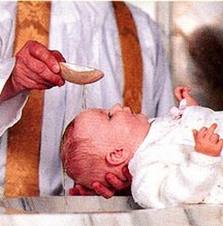
Over the past 30+ years of baptizing infants, children and adults, I have had many occasions to inform parents, godparents, and sometimes even the persons being baptized (if they are old enough) just what Baptism means.  Obviously, the outward sign of pouring of water signifies a cleansing.  By Baptism, we are freed from original sin and (if having reached the age of reason) any personal or actual sin. 
Baptism is our entry into the Catholic Church—we become a Christian.  Baptism is also the doorway to the other sacraments.  Through Baptism we become part of the Mystical Body of Christ as well as an adopted child of God with the privilege of calling God our Father.  We are filled with God’s sanctifying grace and with the Holy Spirit.  We also share in the priesthood of Christ—the priesthood of all believers.

According to the Catechism of the Catholic Church:  “Baptism seals the Christian with the indelible spiritual mark (character) of his belonging to Christ. No sin can erase this mark, even if sin prevents Baptism from bearing the fruits of salvation.  Given once for all, Baptism cannot be repeated.” (1272)
So much happens spiritually through the immersion in or the pouring (on the forehead) of water with an invocation of the Most Holy Trinity:  I baptize you in the name of the Father, and of the Son, and of the Holy Spirit!

While infant Baptism is part of an ancient tradition dating back to the 2nd century, we still have some parents who, on occasion, tell us that they are going to “let their children decide for themselves (about Baptism) when they get old enough.”  I question the logic in this practice.  Don’t parents usually want the best for their children in so many ways?  They want them to go to the best schools, to eat good healthy foods, to wear nice looking clothes, to associate with polite, well-behaved friends, to be successful in life.  Yet, when it comes to a matter like eternal life through Christ, they somehow do not seem to think that faith in Christ is something worth sharing and giving to their children!  I’m certainly confused here!
Although there are currently restrictions (?) on the use of holy water fonts in many churches, there is nothing prohibiting you from coming to church with a container of water to have the priest bless some water for use in your home.  Holy Water is a sacramental reminding you of your Baptism.   Its use helps us to recall how essential Baptism is for the believing, practicing Christian and allows us to renew our own baptismal commitment to Jesus Christ and rejection of Satan in our lives. 

St. Paul tells us: 

Do you not know that all of us who have been baptized into Christ Jesus were baptized into his death?  We were buried therefore with him by baptism into death, so that as Christ was raised from the dead by the glory of the Father, we too might walk in newness of life.  (Romans 6: 3-4)

Fr. Ed Namiotka
Pastor