Showing posts with label St. Teresa of Calcutta (Kolkata). Show all posts

Tuesday, October 4, 2022

Huge Financial Burden on Board


 Dear Parishioners,

Driving down Route 70 yesterday, I stopped for a red light.  The car in front of me had a window decal on it.  I read it carefully.  No, it was not your typical Baby on Board sticker that I had seen many times in the past.  This one, with its silhouette of a baby on it, read:  Huge Financial Burden on Board.  While I initially chuckled—after all, I do have a somewhat quirky sense of humor—I soon realized how sad it was to depict a baby in this manner. We are talking about a person made in the image and likeness of God. Someone who has been given the gift of life through a unique cooperation between parents and Almighty God. This human person was now sadly viewed through the perspective of household economics.

From a Catholic Church perspective, October is set apart as Respect Life month.  The Church continues to teach that every human life is sacred from the moment of conception until natural death.  Recall that Jesus—the Second Person of the Blessed Trinity—chose to become one of us, His creatures.  Jesus was conceived in His mother Mary’s womb. At a given point in time He was an embryo, a fetus, an infant, a child, an adolescent and an adult human being. Our life has so much dignity and importance that Christ not only became one of us, but He also willingly gave His life to save us from sin and death.    

In addition, October is also the month of the Holy Rosary. Just think of some of the joyful mysteries of the Holy Rosary and their connection to various human life issues. The first joyful mystery, the Annunciation (Lk. 1: 26-38), shows us how with Mary’s “yes” to the angel, the Word became flesh in her womb. God became Incarnate with Jesus’ human life beginning at conception.  After Jesus was conceived in Mary’s womb, when Mary greeted her cousin Elizabeth [the Visitation (Lk. 1: 39-56)], John the Baptist leaped for joy in Elizabeth’s womb.  Remember Elizabeth was in advanced years—a situation that today may be too easy an excuse to have an abortion.  When Jesus is born in a stable in Bethlehem [the Nativity (Lk. 2: 1-7ff.)] with no room for Him anywhere else, I can just imagine someone today saying: “This child is a huge financial burden for us! We can’t afford this child!” Sadly, these are just some reasons that can be rationalized for terminating an unwanted or inconvenient pregnancy.

Later in the evening that same day, after dinner with a brother priest, I had the privilege of viewing the new movie about Mother (Saint) Teresa of Calcutta. Sponsored by the Knights of Columbus, Mother Teresa: No Greater Love combined her life history with the work of her community (Missionaries of Charity) throughout the world today. Her expressed desire was not only to serve the poor, but the poorest of the poor. The film brilliantly shows how she respected the dignity of every human person without counting the cost and regardless of any danger or perceived difficulty.  Unfortunately, the film was only in theaters for two days (October 3 and 4) but I am sure will be made available by other means (streaming, DVD, etc.) in the future. It is well worth your time to watch it!

I find it quite frustrating and tragic today, when so many politicians want to show others how they will support a women’s right to choose, they continue to deny and disregard the value and dignity of the developing child in the womb. If people are honest and have integrity, they will admit how science definitively shows that a new human life begins at conception. This new, innocent person deserves to be given a chance to live in this world.  

Mother Teresa saw that so clearly. 

Fr. Ed Namiotka

Pastor


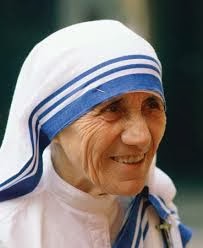
Mother Teresa


Tuesday, September 6, 2016

"I Thirst"


Dear Parishioners,

This past week the Catholic Church and the entire world witnessed Pope Francis, before a crowd estimated at 120,000, canonize Mother Teresa of Calcutta (Kolkata) a saint.  The actual canonization is the end of a long process of investigation into the life and work of a particular person who was recognized for holiness of life in imitation of Jesus Christ.

Mother Teresa was born Gonxha Agnes Bojaxhiu to Albanian parents on August 26, 1910.  At age 18 she entered the Sisters of Loreto (Institute of the Blessed Virgin Mary) in Ireland.  She was sent by her religious order to India where she became a geography and catechism teacher and eventually headmistress of school.  While recovering from tuberculosis, in 1946 she is said to have received a “call within a call” from God to found what would become the Missionaries of Charity.

This newly formed religious congregation (1950), beginning with just a dozen sisters, established its first home for the dying in 1952.  What followed later included clinics for leprosy (Hansen’s disease), orphanages, AIDS clinics, and various centers of charity (approximately 450 worldwide) caring for refugees, the blind, the elderly, the disabled, alcoholics and drug addicts, prostitutes, battered women, the homeless, victims of natural disasters and many others including the “poorest of the poor.”

Mother, who spoke 5 languages, was awarded the Nobel Peace Prize in 1979.  Her order currently has over 5000 religious sisters, along with religious brothers and priests, serving in some 139 countries.  Since 1990, over 1 million volunteers have assisted in the work of the Missionaries of Charity worldwide.  Mother died of a heart attack on September 5, 1997.  Affectionately known as the “saint of the gutters” during her lifetime, she was officially declared a saint just 19 years after her death.

More recently it was revealed that Mother had a long period of spiritual dryness—something of a dark night of the soul—where any feelings of consolation from God were noticeably absent from her life.  Despite this struggle, she continued to serve the Lord faithfully even with ongoing physical problems including 2 heart attacks, a pacemaker, pneumonia, malaria, and a broken collar bone.

Pope Francis spoke the following during his homily at the Mass of canonization:
       
Mother Teresa, in all aspects of her life, was a generous dispenser of divine mercy, making herself available for everyone through her welcome and defense of human life, those unborn and those abandoned and discarded. She was committed to defending life, ceaselessly proclaiming that “the unborn are the weakest, the smallest, the most vulnerable.” She bowed down before those who were spent, left to die on the side of the road, seeing in them their God-given dignity; she made her voice heard before the powers of this world, so that they might recognize their guilt for the crime – the crimes! – of poverty they created. For Mother Teresa, mercy was the “salt” which gave flavor to her work, it was the “light” which shone in the darkness of the many who no longer had tears to shed for their poverty and suffering.
In every convent chapel of the Missionaries of Charity next to the crucifix are the words:  I Thirst.  These are Christ’s own words (Jn. 19: 28) from the cross.  Mother commented on the phrase to her religious sisters in a letter:

Why does Jesus say "I thirst"?  What does it mean?  Something so hard to explain in words - if you remember anything from Mother's letter, remember this - "I thirst" is something much deeper than just Jesus saying "I love you."  Until you know deep inside that Jesus thirsts for you - you can't begin to know who He wants to be for you.  Or who He wants you to be for Him .  .  .  .   
How to approach the thirst of Jesus?  Only one secret - the closer you come to Jesus, the better you will know His thirst.  "Repent and believe", Jesus tells us.  What are we to repent?  Our indifference, our hardness of heart.  What are we to believe?  Jesus thirsts even now, in your heart and in the poor - He knows your weakness, He wants only your love, wants only the chance to love you.  He is not bound by time.  Whenever we come close to Him - we become partners of Our Lady, St John, Magdalen.  Hear Him.  Hear your own name.  Make my joy and yours complete.

Fr. Ed Namiotka
Pastor 


Tuesday, November 19, 2013

When Do We Say “Enough is Enough?”


Dear Parishioners,

I started and finished my Christmas shopping yesterday.  I pulled into a Hess station, and purchased this year’s featured toy truck for my two young nephews (who really seem to be into trucks and cars), and it was over.  Christmas shopping completed for another year!  Woo-hoo!!!!

Truth be told, I can’t see all the wasted time, energy and frenzy surrounding events like Black Friday.  Each year for Christmas I choose a religious Christmas card for my other nieces and nephews and place either money or a gift card in them.  My brothers, sister (and their spouses) and I generally have limited or entirely eliminated buying things for each other.  I remember my mom each year by taking her out to dinner and/or planning a trip with her sometime later—something she really enjoys.

What I have to say here has nothing to do with stimulating the economy or supporting our local merchants and has everything to do with resisting the materialism and the consumer mentality that has seemingly swallowed up the true meaning of Christmas.

When I saw certain retail stores advertize pre-Black Friday sales, and encourage shopping on Thanksgiving Day itself, I have to say “Enough is enough!”  Thanksgiving for my siblings and me is a family holiday where we get to spend some quality time with each other.  If people resist buying on such a day, then the stores would see that there is simply no profit in opening at this time and would cease this practice.  No profit would translate into don’t open today.

It is like many other things in our society that indicate we have certain priorities out of whack.  As long as we are willing to pay astronomical ticket prices for athletes and entertainers, as long as we feel the need for status symbols like over-priced luxury cars, extravagant jewelry and the latest electronics, as long as so many unborn children are seen as disposable, as long as the worship of God appears to be on or near the bottom of our priority list, then our Western society will continue to suffer from a disastrous, spiritual poverty.

St. Teresa of Calcutta had some thoughts on this spiritual poverty:

The greatest disease in the West today is not TB or leprosy; it is being unwanted, unloved, and uncared for.  We can cure physical diseases with medicine, but the only cure for loneliness, despair, and hopelessness is love.  There are many in the world who are dying for a piece of bread but there are many more dying for a little love.  The poverty in the West is a different kind of poverty -- it is not only a poverty of loneliness but also of spirituality.  There's a hunger for love, as there is a hunger for God.   
Filling our narcissistic tendencies with things and more things will only bring more emptiness.  Finding time for God, for our families and to love one another will fill the void in each of us.

We need to say:  “Enough is enough!”


Fr. Ed Namiotka
Pastor

St. Teresa of Calcutta