Tuesday, April 28, 2015

Weekend (Parish) Update


Dear Parishioners,

I write this week to update you on some of the current happenings at St. Joseph Church.

First, during his visit here on Holy Thursday, Bishop Dennis Sullivan officially re-accepted Mr. Anthony Infanti as a candidate for the priesthood for the Diocese of Camden.  Anthony will continue his seminary training at the Immaculate Conception Seminary School of Theology at Seton Hall University, South Orange, NJ.  Anthony will remain at our parish until later this summer when he will begin his theology classes.  In the meantime, Anthony has been given permission to give some reflections during daily Mass.  While this is not officially a homily as a priest or deacon gives, these reflections will be part of Anthony’s preparation for the very important task of preaching in the future.  Anthony also represented our parish as he ran in the iRace for Vocations 5K last Sunday in Sewell, NJ.

Next, we are in the midst of some very important sacraments for our young people.  Confirmation of our youth (and one adult) was conferred by Bishop Sullivan on April 18th.  We congratulate our students on completing their sacraments of initiation.  This weekend, as well as last, we are privileged to see our children receive their First Holy Communion (during the 5:30 pm Saturday and 10 & 11:45 am Masses on Sunday).  The large number of children is a very positive sign for the future.  I take this opportunity to remind parents that they are the first and (hopefully) the best teachers of their children in the matters of our Catholic faith.  It is the parents’ responsibility to be sure that their children attend Mass weekly, go to the Sacrament of Penance and Reconciliation (confession) on a regular basis, pray in the home, be taught to love God and our neighbor, etc.  There is nothing more important than the imparting of our faith in Jesus Christ to our children.

Our parish business manager, Ellen Hyatt, has decided to lessen her workload and retire from the parish portion of her job.  She will continue to work for the elementary school, as needed.  We are currently accepting applications to fill this part-time position.  Applications can be sent to me via the parish office.  We thank Ellen for her hard work and dedication to our parish over the years.

Fr. Alfred Onyutha, who was assigned to St. Joseph Parish a few years ago, is celebrating his 25th anniversary as a priest this year.  Coming from Uganda, Africa (Catholic Diocese of Nebbi) he has only minimal friends and family here from his home country to help him commemorate this milestone.  Fr. Al will be the main celebrant at the 11:45 am Mass on Sunday, May 24, followed by some light refreshments (courtesy of our Knights of Columbus).  Please come to be a part of Fr. Al’s family away from home as we pray and celebrate with him.

Finally, in case you are wondering about the status of our parish pastoral council, it was unfortunately put on a back burner temporarily.  My hope is that it will be functioning soon.  I will keep the parish informed of any progress.

Please keep me in your thoughts and prayers as I continue to seek the Lord’s strength and guidance as your pastor.  In my weakness, sinfulness and sometimes disorganization, God somehow mysteriously uses me and works through me.  Miracles never cease.  I am living proof.


Fr. Ed Namiotka
Pastor
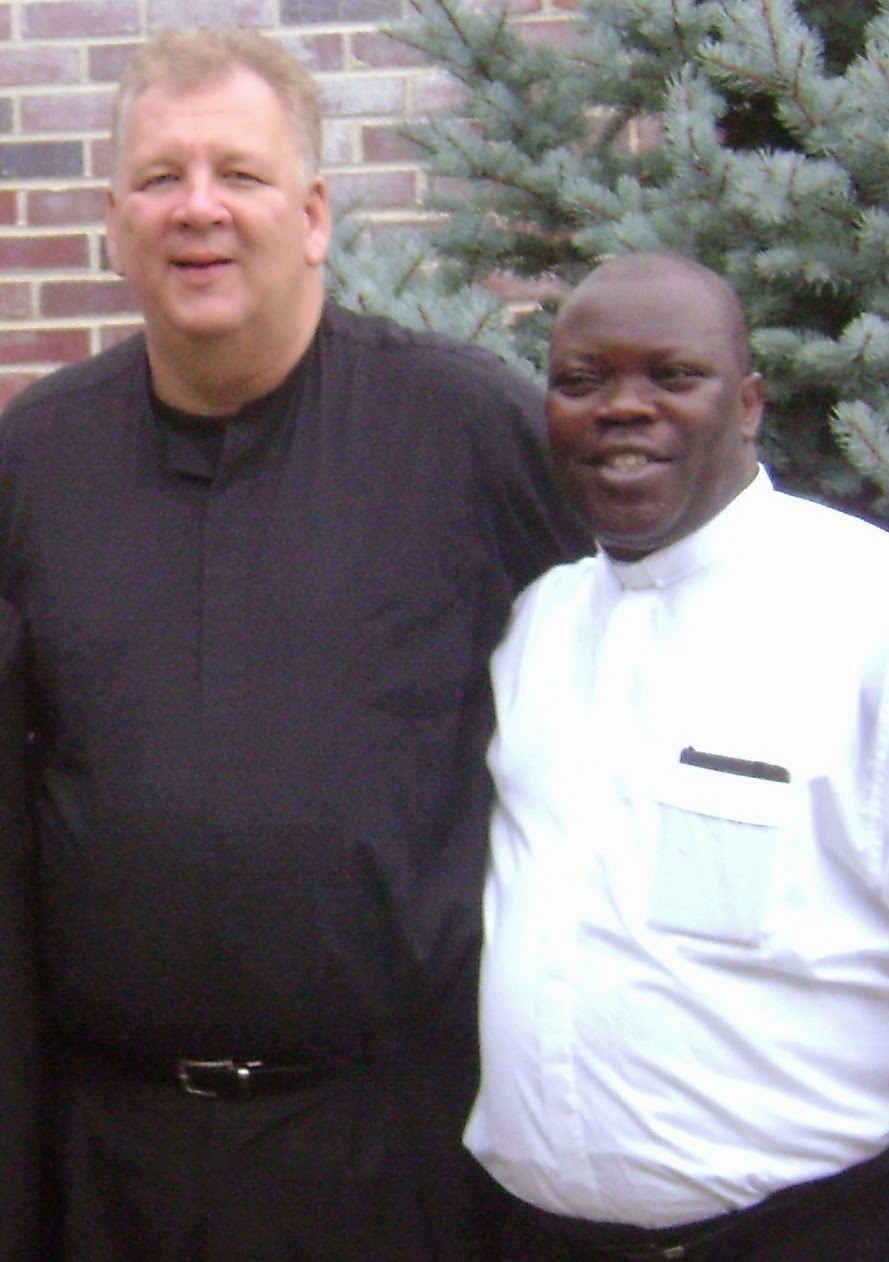
Fr. Alfred Onyutha and me


Tuesday, April 14, 2015

“Who Do People Say that I Am?”


Dear Parishioners,

Now Jesus and his disciples set out for the villages of Caesarea Philippi.  Along the way he asked his disciples, “Who do people say that I am?” (Mk. 8:27)

At a certain point during his ministry Jesus asked His disciples what people thought about Him.  I’m pretty sure He was not concerned about public opinion in a manner that a politician might question his or her current approval rating.  He, more than likely, wanted to know if people (including his disciples) understood that He was the Christ—the long awaited messiah.  Peter seemed to get it right—“You are the Messiah.” (Mk. 8:29)—but unfortunately was not able to keep to this conviction when the pressure of persecution surrounded him.  Others who may have perceived Jesus as messiah might have had a distorted concept of what the messiah was actually supposed to be.  Certainly, he was not to be a suffering messiah.
 
I am pretty sure Jesus knew who He was and understood His purpose in this life.
 
Unfortunately, people still question, comment on and speculate about Jesus’ identity.  Some see him as a prophet, a wise teacher, a holy man or a philosopher.  Others will proclaim His true divinity like the centurion at the foot of the cross, “Truly this man was the Son of God!” (Mk. 15:30) or the apostle Thomas, “My Lord and my God!” (Jn. 20:28).

We all must question who Jesus is at some point or another.  Christians believe that He is the Son of God, the Second Person of the Blessed Trinity.  Therefore, what He has to say matters more than any mere philosopher, teacher, or holy person.   Bold statements in Scripture affirm Jesus divine authority:

“I am the way and the truth and the life.  No one comes to the Father except through me.” (Jn. 14:6) 

“Again the high priest asked him and said to him, “Are you the Messiah, the son of the Blessed One?”  Then Jesus answered, “I am; and ‘you will see the Son of Man seated at the right hand of the Power and coming with the clouds of heaven.’” (Mk. 14: 61-62)

"They came bringing to him a paralytic carried by four men.  Unable to get near Jesus because of the crowd, they opened up the roof above him.  After they had broken through, they let down the mat on which the paralytic was lying.  When Jesus saw their faith, he said to the paralytic, “Child, your sins are forgiven.”  Now some of the scribes were sitting there asking themselves, “Why does this man speak that way? He is blaspheming.  Who but God alone can forgive sins?”   Jesus immediately knew in his mind what they were thinking to themselves, so he said, “Why are you thinking such things in your hearts?  Which is easier, to say to the paralytic, ‘Your sins are forgiven,’ or to say, ‘Rise, pick up your mat and walk’?   But that you may know that the Son of Man has authority to forgive sins on earth”—he said to the paralytic, “I say to you, rise, pick up your mat, and go home.”  He rose, picked up his mat at once, and went away in the sight of everyone.  They were all astounded and glorified God, saying, “We have never seen anything like this.” (Mk. 2: 3-12)

Bluntly stated, we cannot remain simply indifferent about Jesus and His teaching.  Even worse, we are making serious, potentially deadly mistakes (grave sin) when we knowingly defy His ultimate authority and teaching as the Son of God.  

Jesus’ words and teaching are life-giving.  He came to save us from eternal death.  He died for our sins and our salvation.
  
Jesus is Lord, God and Savior.  

Other lesser designations or descriptions are woefully deficient.


Fr. Ed Namiotka
Pastor

Wednesday, March 18, 2015

Guess Who’s Coming for (Holy Thursday) Supper?


Dear Parishioners,

I received a call recently from Bishop Dennis Sullivan’s priest-secretary, Fr. Michael Romano, informing me that our bishop desires to celebrate the Holy Thursday Mass in our parish.  Naturally, I welcomed the opportunity and invited the bishop (and his entourage) to dinner at the rectory beforehand.

A priest or deacon necessarily works in conjunction with his bishop.  The bishop is the chief shepherd—chief teacher, preacher, administrator—of the diocese.  We pray for him (and the pope) by name at every Mass celebrated in his diocese.  We look to him for guidance and direction as the chief spiritual leader of our local (diocesan) church.  We know all too well that bishops are imperfect sinners like the rest of us, and they need our continual prayers to assist them in the difficult task of shepherding God’s flock.

F. Y. I., Bishop Sullivan is also scheduled to be with us to administer the Sacrament of Confirmation on Saturday, April 18th at 10 AM and 1 PM.  (Just a reminder: there will be no 8:30 AM Mass that Saturday morning.)

Holy Thursday is a most important day for priests.  We commemorate it as the day the Holy Eucharist was instituted—the first Mass, so to speak.  Also, we realize the intimate connection between the ministerial (ordained) priesthood and the Holy Eucharist:

The intrinsic relationship between the Eucharist and the sacrament of Holy Orders clearly emerges from Jesus' own words in the Upper Room: "Do this in memory of me" (Lk 22:19).   On the night before he died, Jesus instituted the Eucharist and at the same time established the priesthood of the New Covenant . . . .   The Church teaches that priestly ordination is the indispensable condition for the valid celebration of the Eucharist.  Indeed, "in the ecclesial service of the ordained minister, it is Christ himself who is present to his Church as Head of his Body, Shepherd of his flock, High Priest of the redemptive sacrifice." Sacramentum Caritatis, Pope Benedict XVI
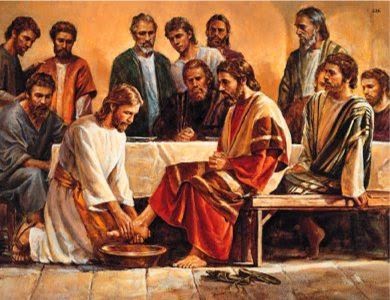
Additionally, we are reminded of our call to Christian charity and service as Jesus’ disciples by the foot-washing ceremony (mandatum).  As Jesus washed the feet of his disciples at the Last Supper (John 13: 1-20)—something only a Jewish slave would do—we are given a command or mandate to Christian charity and service, in imitation of him.

Finally, we are given time at the conclusion of Mass to keep watch with Christ (see Mt. 26: 36-46), truly present in the Holy Eucharist at a side altar-shrine in the repository.

Please try to join us for this Mass (Thursday, April 2 at 7 PM), as well as the liturgy on Good Friday (April 3 at 3 PM) and for the Easter Vigil (Saturday, April 4 at 8 PM).

Holy Week and its ceremonies are especially beautiful and grace-filled.  Please come!


Fr. Ed Namiotka
Pastor

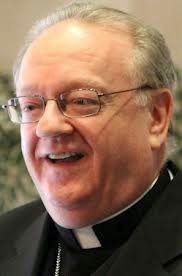
Bishop Dennis Sullivan
  

Thursday, February 12, 2015

50 Shades of "Insanity"


Dear Parishioners,

No, I did not read the book.  No, I have no intention of seeing the movie.  Really, I would rather not bring attention to this insanity at all.  However, before viewing another film (The Imitation Game) on a recent guys night out, the trailer for a soon-to-be released—just in time for Valentine’s Day!—movie appeared.  The coming attractions for 50 Shades of Grey, in and of themselves, made me quite nauseous.  This trailer unfortunately led me to investigate things that I would rather not even think about—ever.

I read a synopsis of the book.  I discovered that it was part of a trilogy.  I had to put  together only a few pieces of the puzzle to realize that I was dealing with the glorification of abusive relationships and extreme sexual perversion.  I was encountering things so dark and demeaning, so sexually distorted and offensive that I dare not describe them here.  Ironic, isn’t it, how President Obama and a victim of sexual abuse, Brooke Axtell, recently appeared during this year’s Grammy Awards to denounce violence against women?  Meanwhile, a novel like 50 Shades of Grey sells over 100 million copies worldwide and is translated into 52 languages.  Global insanityYou betcha.

Today’s culture has so many radical distortions of the true beauty and meaning of human sexuality.  Do we remember at all that God is the author of life and of the very manner in which we reproduce?  Sex is part of His plan and it is holy and good in its proper context—marriage

What’s the big fuss about sexuality, FatherThe Church needs to stay out of the bedroom!  After all, you priests are part of the problem!  Clean up you own act first!

Mea culpa. Mea culpa. Mea maxima culpa. (Sin is still sin no matter who commits it.)

The crux of the problem, as I see it, is that the bedroom is far from private these days.  It is literally in our faces.  It is seen explicitly on television, On Demand, in the movies, in books and magazines, on the internet, etc., etc.—in the most graphic and obscene ways.  More and more perversion, deeper and deeper darkness, the glorification of sin and recreational sex, no traditional moral guidelines, further and further down the rabbit hole . . . .  How bad is it going to get?  I thought that we hit rock bottom years ago!  Foolish me.  (And it severely damages the entire culture—including its priests and religious.  We do happen to live in the same world, don’t we?)         
   
A few years ago, when I talked to a Trappist monk, Fr. John Eudes Bamberger, OCSO, the retired Abbot of the Abbey of the Genesee (Piffard, NY) while on retreat, he said something to me that I ponder regularly:  “Our world is gravely sick with perversion.”  He was well aware of this fact even from behind the cloistered monastery walls, living as a hermit!  The cancerous cells of sin have a strange way of attackingseeking to damage and ultimately to kill any and all organs of the body—even within the mystical Body of Christ!  

Ash Wednesday begins another season of Lent.  It is a time of repentance and a call to follow the Gospel.  

Jesus brings sanity and healing to our world.  He brings truth, clarity, and meaning to our lives.

Hopefully, we all will realize it before it’s too late!


Fr. Ed Namiotka, Pastor


Tuesday, January 20, 2015

An "Unusual" Experience at the Movies


Dear Parishioners,

A well-done work of art has the ability to provoke thought, to inspire, to elevate the mind and the heart, to stimulate the emotions, and to bring out the best in humanity.  This is true whether it is a painting, a song or musical composition, a play, a sculpture, a novel or poem, an architectural wonder or a movie.  There is definite value to good art.

Last night I went with another priest and his dad to see “American Sniper” at the movies.  I don’t pretend to be a film critic, but I can tell you that I thought the film was done superbly.  Five Stars.  It definitely made me think and question.  It pulled at the heartstrings.  It made me realize what soldiers sacrifice to defend our nation and its values.  It detailed the tragedy of war.  It showed us that evil definitely exists in our world.  It made me proud to be an American.  At the end, I witnessed everyone in the theater remaining seated for a few moments speechless in an eerie, deafening silence.  I have seldom experienced this reaction by an entire group of people in a packed theater.

What follows is a synopsis (by Jeremy Wheeler) of the film by director Clint Eastwood.  It is a:

Biopic of Chris Kyle (Bradley Cooper), the most-celebrated sniper in American military history. In the aftermath of 9/11, Kyle decides to serve his country by becoming a Navy SEAL. But with each tour of duty, he grows more detached from his wife and children.

As the story opens, we meet carefree brothers Chris and Jeff (Keir O'Donnell) as they work the Texas rodeo circuit. They're cowboys through and through, and despite being notably older than the usual enlistee, Chris pays a visit to his local recruitment office and decides to become a Navy SEAL. Later, at the firing range, he draws on his hunting lessons with his stern father to become an expert marksman. A booze-fueled barroom chat with pretty brunette Taya (Sienna Miller) soon leads to wedding bells, and following the terrorist attacks of 9/11, Kyle is deployed to Iraq for his first tour of duty. There, his reputation as a sniper who never misses makes him a legend among his fellow troops, and earns him the moniker "The Devil of Ramadi" from his enemies.

With a substantial bounty on his head, Kyle makes it his personal mission to take out a sadistic Iraqi soldier known as "The Butcher," as well as an elusive enemy marksman with a skill to rival his own. The closer he gets to achieving his goals during repeat tours of duty, however, the more fellow soldiers he sees die, and the further he drifts from Taya and their two children back home. It all leads up to a tense rooftop gunfight in a raging sandstorm -- one that convinces the sniper once and for all to make his family his top priority. Unfortunately, all is not well as Kyle struggles to make the transition back to civilian life, but he discovers that helping his fellow veterans is an effective way to do good and make peace with his wartime experiences.

If you decide to see the film, I caution that it is not for children or for the faint of heart. War and killing is a very difficult topic to digest, even in our much desensitized world.  We are reminded how every time, place and generation seems to encounter evil as it rears its head over and over and over again.

Personally, I thank God for the brave men and women who defend and protect our nation and who allow us to sleep safely each night.  May we never forget them or the difficult lives that they inevitably face when they choose to serve in our military throughout our troubled world.  

May our prayers always be with you!


Fr. Ed Namiotka
Pastor

      Chris Kyle

Sunday, January 18, 2015

“There is No Vacation from God”

Miami Beach (as seen from the ship)

Dear Parishioners,

As a teacher I told my students hundreds of times that there is no vacation from God—especially during their summer and holiday breaks.  Now I find myself with my mom on a brief Caribbean cruise while trying to maintain some semblance of a prayer life.  Last year I took a cruise while working as a chaplain for the ship.  Mass was built into the daily schedule as an option for the passengers during their cruise vacation on that particular cruise line.  However, this year I am simply another passenger on another cruise line that does not offer their guests the opportunity of a Catholic Mass each day.

Really it is not that big of an issue for my mom and me.  I inevitably pack a small “Mass kit” which enables me to offer Mass no matter where I am.  Mass this past Sunday was celebrated privately in our cabin, as it was the other days of our cruise.  However, I thought about the other guests on board—approximately 4000 of them—and realized that there was no such opportunity for them while at sea to attend even Sunday Mass.  (I did note, however, that an “Episcopalian Mass Service” was listed in the itinerary for Sunday.)

Maybe I’m strange, but if I were not a priest, this would be an important consideration for me as part of my vacation.  I would want to travel where God was not something of an afterthought.  If one cruise line offers a Catholic chaplain daily and another does not, I should probably consider choosing the one offering me the possibility for some spiritual nourishment.  After all, no matter what cruise line, there is inevitably plenty of food to eat, enough excursions to keep a person constantly on the go, entertainment galore, and an immense ship providing just about every amenity that you can imagine.  Would it be too much to ask that a Catholic chaplain be provided as part of the cruise, when possible?  Various cruise lines have obviously found a way to do this since I had participated in such a program just last year.  In fact, I witnessed sincere gratitude by passengers and crew who were both glad that I was there to offer Mass for them.
 
I am also sad to report that I could not locate even an interdenominational chapel on this newest of cruise ships as I have found on other older ships and on other cruise lines.  My current ship boasts of a seemingly endless number of possibilities available to keep a person on the verge of being gluttonous, pampered and entertained.  To me this is a sad indication of the secular, materialistic world in which we live.  Apparently, there is simply no place and very minimal time (if any) for God.

If we want to be a seriously devout, prayerful Catholic (Christian), it involves basic things such as starting and ending each day with prayer, praying during meals, finding sometime during the day to be quiet and reflective, reading the Scriptures, and attending Mass minimally each Saturday evening / Sunday—even on vacation.  I can see, however, how hard it can be even for a priest to maintain something of a prayerful routine while on vacation.

Be assured that even when I am away, you are remembered in my thoughts, prayers and Masses (in the cabin!).


Fr. Ed Namiotka
Pastor


Friday, December 5, 2014

Making Sense of Holy Days


Dear Parishioners,

With the Solemnity of the Immaculate Conception coming up next Monday (December 8th), I thought that this article might be helpful.

“Why do we have to attend Mass some years on a particular holy day, and on other years there is no obligation to attend Mass?”

Holy Days of Obligation often generate confusion and need clarification. In the universal Catholic Church there are ten of these days. However, each individual country is allowed--through its conference of bishops (the USCCB in America)--to decide which days are to be observed and how they are to be observed.

In the USA, the conference of bishops chose to move the observation of a number of these Holy Days to Sunday (such as Corpus Christi and the Epiphany). Still, six are retained on their actual calendar dates:

  • January 1--The Solemnity of Mary, Mother of God
  • August 15--The Assumption of the Blessed Virgin Mary
  • 40 days after Easter--The Ascension of Our Lord (Ascension Thursday)
  • November 1--All Saints Day
  • December 8--The Immaculate Conception of the Blessed Virgin Mary
  • December 25--Christmas


What is perhaps one of the most confusing aspects for almost everyone is the question: “why are we obliged to attend Mass some years and not others?” Basically, when the Holy Days fall on a Saturday or a Monday—being so close to Sunday—the bishops of the USA removed the obligation to attend Mass on those days.

This is true except for the Immaculate Conception (the Patroness of the USA) and Christmas. We observe these days no matter when they occur.

[Please note, this year (2014) there is no vigil Mass on Sunday evening for the Immaculate Conception. The evening Mass on Sunday is for the 2nd Sunday of Advent.]

Now that you are thoroughly confused, I want to make a few important points for you to consider.

First, if the universal Catholic Church has considered these days holy, then they deserve our attention, consideration and observance no matter when they occur (or whether or not we are required to attend Mass).

Second, I hate to see people become so legalistic that we are constantly looking to observe the bare minimum that we could possibly do for God. We should develop an attitude of generosity toward God and not an attitude resembling something like a minimum daily requirement. What if God had that type of attitude toward us?

Finally, these holy days should be a reminder for us to try to bring the sacred into our daily routine.

There are so many things that can distract us from God in the world today. Recalling and observing these sacred days and the events that they represent are a good way for us to Christianize our lives, family and world.

I hope to see you in Church at Mass on these days because you want to be there, not because you sometimes are obliged to do so.

Fr. Ed Namiotka

Pastor

Thursday, November 20, 2014

Happy New Year! (Well, Sort of)


Dear Parishioners,

As I write, I am making my annual retreat.  It is a time of prayer, reflection, renewal and relaxation.  This year I am at Trinity Retreat in Larchmont NY, a retreat house operated by the Archdiocese of New York.  (This reflection, however, will be seen in the church bulletin on the 1st Sunday of Advent, after I have already returned to the parish.)

Our retreat master during his talks referred to the Advent fast on several occasions.  I kept thinking to myself, most people have lost any sense of relevance that the season of Advent is intended to bring, let alone understand that it is meant as a season of hope, expectation, waiting and—believe it or not—fasting.

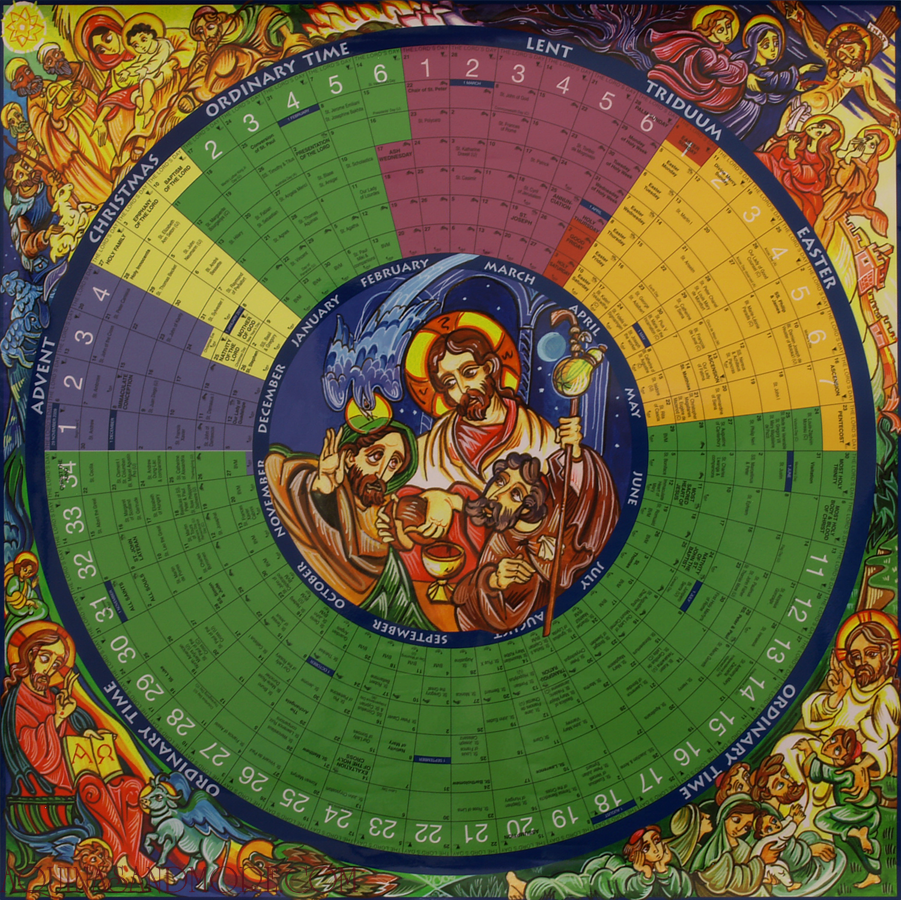
Let me begin with the reminder that the liturgical year for the Catholic Church begins with Advent.  Happy New (Liturgical) Year!  The origin of the word Advent is from the Latin, meaning a time of “coming.”  We are preparing to celebrate the Nativity of Jesus at Christmas, but also to anticipate that He “will come again in glory to judge the living and the dead.”  (Nicene Creed)

Four Sundays are given to us to prepare, symbolized by the four candles of the Advent wreath and a change of vestment color.  The purple (violet) color on the candles of the wreath and vestments traditionally represent penance and fasting while the rose candle on Gaudete Sunday symbolizes rejoicing and joy. 

While Lent is considered the great fast, Advent was also considered a time of fasting and penance.  From the 6th century we have evidence in the Church that there was a fast during Advent on Mondays, Wednesdays and Fridays.  While the fast was reduced significantly over time, the Advent season is still meant as a spiritual preparation for the great solemnity of Christmas.

What is unfortunate these days is that the commercial Christmas celebration starts much too early—driven by a oppressive consumer mentality—omitting any notion whatsoever of spiritual preparation or penance prior to the Nativity of Jesus Christ.  Advent gets lost in the shuffle, unfortunately.  People quickly grow tired of Christmas and its commercial trappings, and begin removing the decorations almost immediately after Christmas day itself.  Instead of the Church being able to Christianize an ever-more worldly society, our secular culture appears to be winning and has relegated anything spiritual to insignificant, irrelevant and passé.  God help us!

I know that the anticipation of the Christ Child still brings hope to many lives.  For those who truly try to pray, to spiritually prepare with a sacramental confession, and even to fast, the joy that comes from readying our hearts for the coming of Jesus surpasses any temporary, illusory pleasures that the many TV commercials promise.

As a child once expressed it, Christmas is all about the peace that is found in the room when everyone stops opening the presents and just listens.
 
Come Lord Jesus!


Fr. Ed Namiotka
Pastor

Tuesday, October 28, 2014

Avoiding the Pitfalls of Pelagius


Dear Parishioners,

One of the heresies of the early church was called Pelagianism.  It was named for Pelagius, who was thought to have been either a British or Irish monk (an aesthetic), living around the late 4th or early 5th century.  His teachings were opposed by St. Augustine and were officially condemned by the Council of Carthage (418-9).   One core error associated with his teaching was the belief that human beings can earn salvation by their own efforts, unaided by God’s grace.  Essentially, the heresy can be remembered this way:  “I can do it all by myself.  I don’t really need God’s help!”

Sometimes people may think similarly about salvation in our contemporary society.  Perhaps there are those who think that if we do enough good deeds, accumulate enough “brownie points” before God, then He has to let us into heaven.  After all, we earned it!  How often have we heard a list of accomplishments—a curriculum vitae—at various occasions indicating how much a person has achieved in his or her life?  Do we really think that we will hand God our resume, show Him our multiple academic degrees or inform Him of our lifelong accomplishments so that we will be let us into Heaven to share eternal life with Him?

The primary focus regarding salvation can never be on us, but has to be on JesusHe suffered and died for our salvation.  His death on the cross is the means by which our sins are forgiven and we are given the glorious possibility of eternal life.  It’s really all about Jesus, and not all about us!  Moreover, every good work of ours has its origin in God’s grace, is sustained by God’s grace and is brought to completion with God’s grace.  Yes, we still retain our free-will—but we never do it all alone, like some rugged individual.

Sadly, a typical situation in which this Pelagian thinking manifests itself is in our funeral rites.  The term used today reveals a lot:  the celebration of life memorials!  The focus here is presumably on what the person has done, and not on what Jesus has done for us.  (I unfortunately anticipate that there is going to be some pushback in this regard!)  During funerals, there necessarily has to be an emphasis on Christian hope—with all its encouragement—given to us who are left behind.  This is because Jesus is the firstborn from the dead (see Col. 1:18 or Rev. 1:5). 

However, we can never become so overly presumptuous as to place a person in Heaven automatically.  Only God Himself reads the heart, knows the person’s motivation and understands the human person so completely as to be the ultimate judge of anyone’s salvation.  Jesus died for us sinners, and we need to ask for His forgiveness and mercy for our deceased.  We should never deprive anyone of our prayers and Masses, offered for their eternal salvation.  The Catholic Church’s teaching on purgatory, a period of cleansing or purification before Heaven, can be of great consolation in this matter when it is properly understood.

No, I can’t do it all by myself.  I need Jesus.  I need His grace.  I need His unconditional love, His mercy and His forgiveness—more now than ever!


Fr. Ed Namiotka
Pastor

St. Augustine, Bishop of Hippo
"Doctor of Grace"

Wednesday, October 22, 2014

Preaching the Sunday Homily


Dear Parishioners,

As I write, I am attending our annual Presbyteral Convocation in Avalon.  This meeting of our priests serves a number of purposes:  it renews our priestly fraternity in union with our bishop, it allows us to relax, to reflect and to pray, and it gives us various opportunities to be informed and updated.  This year the main topic of our conferences is preaching.  There is an emphasis on the effective communication of the Word of God, especially during the Sunday homily.

When thinking about this vital task of every priest, I believe that it may be insightful if I tell my own story.  I used to think (as a child and a teenager) that it would be okay to be a priest—except for the part about speaking in public.  I am quiet, shy and introverted by nature and did not have a lot of self-confidence whenever I had to talk in front of others.  This doesn’t exactly bode well if you may have to preach to others on a regular basis.

God certainly has a sense of humor!  What exactly is it that I have spent most of my life doing?  Try teaching in a classroom in front of teenagers and preaching in front of a congregation on a daily basis!

I remember the first homily that I gave as a deacon at Mass.  I had been up all night tossing and turning, so nervous about the task ahead of me.  When Mass began, I had to make a decision.  I could read what I had written from a text verbatim or I could preach (without reading from the text) from my heart.  With the second choice, I would take the chance of freezing up, of forgetting what I was supposed to say and of possibly looking like a fool.  Maybe I should be a fool for Christ (see 1 Cor. 4:10)?  I chose to go without reading the prepared text and stepped up in front of the altar.  I said a simple, spontaneous prayer which I continue to say each and every time I preach:  “Lord, touch my lips that I may touch people’s hearts.”  The rest is history.

Lest people ever think that there is not some vital preparation for my Sunday homily each week, I begin with prayer and a reading of the Sacred Scriptures.  Then I look to some biblical commentary to shed some light on the text itself.  I think of stories, events or examples to make the biblical text come alive and then try to apply it to contemporary situations or events.  In the entire process, I am open to the Holy Spirit to guide me to speak the words that God wants the congregation to hear.

It’s always a challenge to stay fresh, to be interesting and not to seem repetitive.  It is sometimes intimidating to preach the Gospel in season and out of season (see 2 Tm. 4:2), when the message is popular and when it goes against the tide in society.

Most importantly, the Gospel of Christ, when preached in all of its richness and purity, is truly life-giving!  To a world that is hungering for truth, direction, meaning and purpose, the Gospel has the answers!  Together with the Holy Eucharist, it fills the hungers of the human heart.

I will try to do my best to preach it to you accurately, with love and conviction, as God’s Word to us!


Fr. Ed Namiotka
Pastor