Thursday, March 15, 2012

Time Flies When You’re Having Fun!


Dear Parishioners,

On May 16, 1987 I was ordained a priest in St. Ann’s Church, Wildwood.  This year I will celebrate my 25th Anniversary of Ordination to the Priesthood.

With gratitude to Almighty God and in thanksgiving for the continued intercession of the Blessed Virgin Mary, I will offer a Mass of Thanksgiving for family and friends at 2:30 PM on Sunday, May 20th.  Naturally, you are invited to attend this special Mass, if you are so inclined.

In addition, I will be the celebrant of the 10 AM Mass that same Sunday, after which you are invited to join me in the church basement for some light refreshments.  The morning Mass will be a parish-centered celebration to which I cordially invite all of you, my parishioners.

Priesthood is a special “calling” and a unique gift from God for which I will be ever grateful.  Do I deserve such an honor as to share in the Priesthood of Jesus Christ?  Certainly not.  I am reminded of the passage from the Letter to the Hebrews:

Every high priest is taken from among men and made their representative before God, to offer gifts and sacrifices for sins. He is able to deal patiently with the ignorant and erring, for he himself is beset by weakness and so, for this reason, must make sin offerings for himself as well as for the people. No one takes this honor upon himself but only when called by God, just as Aaron was. (Heb. 5: 1-4)

As I express my heartfelt gratitude to Almighty God, I realize that God has given me so much more than I have ever hoped for or expected.  Most especially he has given you to me.  I am honored to be your spiritual father, your pastor, your priest.

God’s love for His people is so great.  It continues to be manifested through the ministry of His priests.  Sinners though we are, we are reminded regularly that it is not our own talents or gifts but rather God’s grace that enables us to lead people to Christ.  After all, Priesthood is never really about me but truly about Christ.  To use the words of John the Baptist:  “He must increase; I must decrease.” (John 3: 30)

Thank you for being a part of my life and my ministry.  I want you to know that I had the following inscribed on the bottom of my chalice when I was ordained:  Lord, bless those who have brought me to and keep me at your altarI depend on your prayers and support as I strive each day to be a better person and holy priest in imitation of Jesus Christ.  While I may unfortunately fail in my attempts, I hope to never give up trying.

Just a few words to those who think they might be hearing the “call” to priesthood as I did:  Don’t be afraid to answer His call!

Nothing that the world offers can compare to the gift of His Priesthood.  Nothing.

Fr. Ed Namiotka
Pastor


Friday, February 24, 2012

Stay Put


Dear Parishioners,

I have only told this story to a few people over the years.  It concerns my having to make a very important decision that, at the time, could potentially affect my future life as a priest.

Let me take you back to that time.
 
I was attending Mt. St. Mary’s Seminary in Emmitsburg, MD.  I was more than halfway through my priestly formation, studying to be a priest for the Diocese of Camden, NJ.

An opportunity arose in which I had the possibility to relocate and continue my studies for the Archdiocese of Philadelphia.  This involved a formal transfer from my home diocese of Camden to Philadelphia (where I was born and attended college seminary).  The transfer would require the consent of the bishops of both localities—and it appeared to be a genuine possibility without any apparent obstacles to this transfer.


In brief, the door opened for me to study for the Archdiocese of Philadelphia and I had to make a potentially life-changing decision—should I stay where I was or go there instead?

I took this question to prayer every day.  I wanted to do whatever the Lord wanted me to do.  I prayed for guidance and direction.  I talked it over with some trusted priests.  I prayed from the depths of my being.  I did not want to make a bad decision. I prayed and prayed and prayed.

In prayer, two words kept coming to me over and over again:  “Stay Put.”   

How do I know if this was God speaking to me or whether this was just my imagination?  I prayed.  I prayed some more.  I prayed unlike I had ever prayed.  I prayed for some sign, some confirmation.

Stay put.  That’s what I “heard” time and time again.  Stay put.  Nothing more!

In the meantime, I had scheduled an appointment at the diocesan office in Camden potentially to finalize my transfer.  I left the seminary in Maryland to drive to the meeting in somewhat of a daze.  It was more than a three hour drive.

Was I about to do something that I might regret for the rest of my life?  It certainly seems like the Lord wanted me to stay where I was.  Lord, help me to make the right decision.

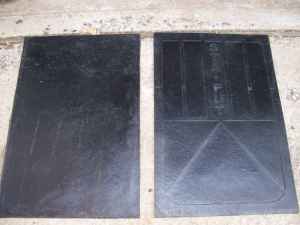
I had stopped at a red traffic light.  I was staring into space.  Then I looked closely at the tractor trailer (semi) immediately in front of me.  I could not believe what I saw!  On the mud flaps on both sides of the truck were two words:  STA PUT.  (Yeah, maybe the spelling was not exact but the message was nonetheless loud and clear!  Alright already, Lord!  I get it!)

Nearly thirty years later, I am a priest of the Diocese of Camden, NJ.  I realize now how God was teaching me how to discern important matters. Prayerintense prayer—was the key to finding God’s will.

Prayer and a particular pair of mud flaps, that is!

Fr. Ed Namiotka
Pastor

Look closely at the mud flap on the right!

Thursday, February 9, 2012

"How Are Things?"


Dear Parishioners,

In a conversation that one of my priest-friends had with a monk while he was on retreat, he asked the monk, “How are things?”  The monk’s response surprised him a bit.  “Things are fine.  It’s the people that I have a problem with!”

For better or for worse, we will have to deal with people for the rest of our lives.  As the British poet John Donne reminds us: No man is an island.  In my analysis of any situation dealing with people, I return continually to the importance of relationship.

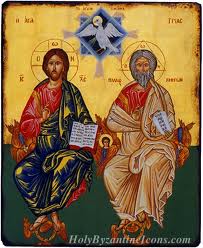
Let’s start first with God.  In the revelation to us of God’s inner make-up, we are shown that God is a Trinity of Persons in relationship—a Father, a Son and the Holy Spirit.  There is perfect unity and harmony in this relationship exemplifying the essence of love.

Moving to the family, which is based on the relationship of husband and wife and the children that are born as the fruit of their love, we can again see the importance of and need for unity and harmony.  The two who become one flesh also must strive for one loving heart and work to provide for, to teach, to protect and, most importantly, to love those innocents whom they bring into this world.

The Church—the Body of Christ—is a community of believers in relationship with each other as well as with Almighty God.  While each and every individual is of utmost importance and value, none of us stands alone within the Church.  Jesus is the Head and we are members of His Mystical Body.  Through the Church’s visible leader, the Pope, in union with the Bishops throughout the world, Christ continues to sanctify, to teach and to preach today.  Again, unity and harmony are ever so necessary for the mission of Christ to continue.  Unfortunately divided Christian communities with varying degrees of dissention (both from within and from those outside of the Church’s embrace), make this goal of unity and harmony a frequently difficult, ongoing challenge.

No matter what the situation that we encounter, we can never forget that concern for the person and the relationship needs to be the most important, underlying principle defining the way that we approach and treat others.  Mutual respect, patience, cooperation, ongoing communication, and forgiveness are qualities and conditions enabling us to achieve this desired unity and harmony in relationships.

Even when dealing with sensitive or volatile topics, if we value the relationship over the issue itself, we may still wind up disagreeing—but we have a better chance of never losing respect for the person or persons holding the differing opinion or position.

Work to build relationships as St. Paul instructs:

I . . . urge you to live in a manner worthy of the call you have received, with all humility and gentleness, with patience, bearing with one another through love, striving to preserve the unity of the spirit through the bond of peace:  one body and one Spirit, as you were also called to the one hope of your call; one Lord, one faith, one baptism; one God and Father of all, who is over all and through all and in all.  (Ephesians 4: 1-6)


Fr. Ed Namiotka
Pastor

Friday, November 18, 2011

The Search for God

Abbey of the Genesee

Dear Parishioners,
Recently I came back from a retreat with the Trappist Monks.  For me, spending time with them is spiritually renewing.  There’s plenty of time to read, to think, to pray and . . . to be quiet.
The former abbot, Fr. John Eudes, gave us a series of talks during the week.  He is definitely one of the most intelligent men that I have ever met.  In the course of the talks he showed a proficiency in Latin, Greek, Hebrew, theology, Sacred Scripture, various complex sciences, philosophy, history and other general information.  He is a medical doctor, a psychiatrist.  And he is quite sharp—even at 85!
It was not necessarily what he said that impressed me the most.  It was more awe at his commitment to serve the Lord as a monk for over 62 years!  And now he is a hermit, living alone, seeking God in the woods of upstate New York.
What leads him—leads us—to seek God?
I remember what one of my seminary professors once taught:  we are wired to seek God.
From our very early days we question things:  Why?  What’s that?  What are you doing? Where are you going?  We want to know things.  We want information.  We seek knowledge.
At the same time, we pursue things in life that seem to bring us happiness.  We desire friendship.  We want to be intimate with others.  We long to be loved and to love.
We are wired so that our intellect seeks knowledge and our free will chooses love.
Where do we find something or, better yet, someone who has the fullness of knowledge and love—who is all-knowing and all-loving?
If you choose God—then you choose correctly!
St. Augustine said this many years ago and it still rings true:  “Thou hast made us for Thyself O Lord, and our hearts are restless until they rest in Thee.”
Whether we think about it or not, we all go about life searching for something or someone to fill a void, an emptiness in us.  A lot of things that may appear “good” and may temporarily bring us pleasure, don’t satisfy completely or totally in the end.  We still carry about an emptiness longing to be filled.
And so we will go on searching . . . searching . . . searching . . .
. . . until we one day find . . .
. . . and are satisfied completely and totally . . .
. . . by God!

Fr. Ed Namiotka
Pastor

(Retired Abbot) Fr. John Eudes Bamberger, OCSO

Friday, November 4, 2011

Going on a Retreat


Dear Parishioners,
According to the Code of Canon Law (church law), priests are bound to make time for spiritual retreats (canon 276 §2, 4).
On many occasions, I choose to join the Trappist Monks—the Order of Cistercians of the Strict Observance (O.C.S.O.)—for a week of prayer, spiritual reading and silence in Piffard, NY.  I stay at Bethlehem Retreat House which is part of the Abbey of Our Lady of the Genesee.  (If you care to, you can read about my retreat last year at the abbey here.)
We hear in Sacred Scripture about Jesus going out into the desert, going up on the mountain, going by the seashore and to other locations to take the time to be alone and to pray.  I think that we all need this time.  Not everyone has the ability to take a week off specifically to do this, but it is a practice which we all need to consider. We should take at least some time regularly for our own spiritual growth and well-being.  A retreat is certainly a possibility to help us.

Retreats can vary in kind, duration and austerity.  The monastic retreat that I choose is meant to be a desert experience.  It involves great periods of silence, praying (chanting) the psalms at least five times a day, celebrating Mass with the monks, some spiritual conferences, a considerable amount of walking to and from the abbey and early rising—very early!  The first time of prayer at Genesee is 2:25 AM!  Early to bed, for sure.

In the midst of this experience I hope to encounter God more profoundly.  Minimize the distractions, eliminate noise, pray more and be open and attentive to the presence of God in my life.  By doing this I am preparing myself—setting the conditions—to "hear" God more clearly.
Every past retreat has borne different kinds of fruit for my life’s journey.  God never seems to be without wonder and surprise as He speaks to the depth of the heart.

While on retreat I will be praying for you, my people.  I will place all of you at the top of my list of prayer intentions as I celebrate Mass, chant the psalms and partake in various spiritual exercises.

Could I ask that you remember me as well in your thoughts, prayers and Masses?  After all, I truly depend on your prayers, support and love to sustain me in my priestly ministry!

Genesee is an abbey where the monks bake bread (Monk’s Bread) and sell it to support themselves.  I hope that I can keep away from eating too many carbs during the week!

Unfortunately, I doubt it will happen!

Fr. Ed Namiotka              
Pastor

Tuesday, November 1, 2011

Say Ahh . . . (men)!


Dear Parishioners,
I prayed at the Wailing Wall in Jerusalem at the turn of the century.  This wall is the remnant of the great Jewish temple destroyed by the Romans in 70 AD.
While there, I noticed how many of the Jewish men bowed continually while praying.  I wondered why?  The practice is referred to as daven.   It can mean both praying and rocking or swaying.  The body itself can be seen as an instrument for praising God coming from an interpretation of the psalms:  My very bones shall say, O LORD, who is like you. . . ?” (Ps. 35:10)
Body movement during prayer—coming from our Jewish brethren—is thus seen as a means of devotion to God!
We, as Catholics, have incorporated quite a few gestures into our liturgy that we might consider:  bowing, kneeling, genuflecting, standing, making a Sign of the Cross, and striking our breast, to name a few.
It was a Jewish professor who I had in graduate school that explained the custom of striking the breast to our class.  He told us that it was a gesture of profound repentance when a person strikes the breast around the heart as if to say:  From the depths of my heart, I am truly sorry.
We need to keep this in mind when we recite the Confiteor during the Penitential Rite of Mass.
Another gesture during the Mass that merits our attention is bowing when mentioning the Incarnation during the Creed.  To acknowledge the fact that God became a man—that the Word became flesh—certainly deserves some special act of reverence on our part!
It also goes without saying that the Eucharist—the Real Presence of Jesus Christ present in our tabernacles and on our altars—necessarily commands our utmost respect by genuflecting or by a profound bow when appropriate.
This brings me to a final point:  the importance of participating verbally during Mass.  I have continually reminded people over the years that our Mass is primarily an act of worship.  It is not some form of entertainment because of the beautiful music.  Nor is it a completely private act of devotion or something that the priest does all by himself while the rest of the congregation watches.  We are all supposed to participate fully.  There are various dialogues and responses given to the prayers that are meant to be said or sung!
One such response—coming from the Hebrew—is the word Amen.  It is a word of affirmation and emphasis.  It is used in the Gospels 77 times and is spoken by Jesus especially when He wants to emphasize something of utmost importance:  Amen I say to you. . .!
So when you hear a prayer prayed, or you come up to receive Holy Communion, voice your belief and conviction by saying Amen!
Knowing why we do and say the things we do during the Mass can only help to enhance our experience of it. 
I hate to see people just go through the motions when there is such richness and beauty to the Mass—especially when properly understood!
Fr. Ed Namiotka
Pastor       

Saturday, October 22, 2011

Like Seeing a Deer in the Headlights


Dear Parishioners,

Do you know that surprised look—the one that they describe like seeing a deer in the headlights?

I’ve seen it quite a few times these past weeks.

Can you imagine trying to leave Mass early and think that you are going to sneak out the side or back door and then encountering a 6’ 6” almost 300 lb. man in black standing there ready to say “hello?”

Gotcha!

It brings me back to my former days as a principal.  Oh those good old days when I was catching students smoking in the bathroom or trying to cut school!

Gotcha!

The look is priceless.  I wish I had a camera.  It would be a perfect post for YouTube.

Try not to make eye contact.  Look down quickly.  Walk fast.  (I wonder what you are thinking.  Well, maybe not.)

Honestly, I really don’t get it.  If you have just received the Body and Blood, Soul and Divinity of Our Lord Jesus Christ, is it really appropriate to leave church while still chewing the communion host? 

What’s the hurry?

I was taught a long time ago—in elementary school, in fact—to make a proper thanksgiving after receiving Holy Communion.

Tell the Lord Jesus that you love Him.  Thank the Lord for all that He has done for you.  Petition the Lord for the various needs that you have.  Tell Jesus that you are truly sorry for all of your sins and beseech His mercy.

If done sincerely, properly and reverently, it takes at least a few quality minutes of your time.

Yes there are some legitimate excuses for having to leave early and this may happen occasionally!  But in all honesty, far too many people have developed a very bad habit of leaving Church before the Mass is ended, before the final blessing, and before the priest has left the altar.

Even if you are not able to receive Holy Communion for some reason, the practice of making a spiritual communion is still a legitimate option.

If this message applies to you, I ask you to think seriously about what I have just said.  While I may be annoyed by this practice, it’s really Jesus who you are disrespecting—to use the language of today’s youth.

Jesus deserves more from us than eating and running.

Save that practice for those fast food joints!

Fr. Ed Namiotka
Pastor

Tuesday, October 11, 2011

“Et Cum Spiritu Tuo”


Dear Parishioners,
Once a priest, at the beginning of Mass, experienced some difficulties with the church’s sound system.  He started tapping the microphone and then muttered in frustration, "There's something wrong with this microphone."
Someone in the congregation who could not hear him dutifully responded, "And also with you!"
For many years, we as Roman Catholics living in the U.S.A. have grown accustomed to various responses and a certain text used for the celebration of Mass.  In November, with the beginning of a new liturgical year—the 1st Sunday of Advent—things will change.
A new translation of the Mass texts will become the norm for the celebration of Mass.
When the Mass was translated into the vernacular from Latin, the accepted translation was less precise because the translators were given some latitude so as not to have the words seem too high or lofty to the people.  The translation we currently use might be termed more pedestrian.
The translation we will be using next month will be more exact and deeply rooted in the biblical translation/meaning of the text.
For example, we are accustomed to saying “And also with you” when the priest greets us with “The Lord be with you.  Soon the response will change to “And with your spirit.”
I borrow the following explanation from Fr. Phil Bloom (Pastor, St. Mary of the Valley Catholic Church, Monroe, WA):        
Why the change?  There are a number of reasons.  First and most important: "And with your spirit" more exactly translates the Latin, "Et cum spiritu tuo."  The Latin itself goes back to the Hebrew.  "Spirit" (ruah in Hebrew) represents the entire person in his unseen dimension—his power to relate to God and to others.  So the congregation is wishing that the Lord be with the celebrant's spirit—his deepest being. To lead the people in worshipping God, the celebrant needs the Lord deeply present inside him.  For that reason you will say to (him), "And with your spirit."
When you stop to think about this change and the many others that are being made like it, we are getting into a deeper, more profound understanding of our faith and its biblical origin.  We are moving from a more pedestrian language to a more theological, biblical language.  Granted, it may seem more lofty (even transcendent) to some, but as a former educator I am tired of people trying to dumb us down.  I believe that we are quite capable of an elevated understanding of matters once things are properly explained to us.
 I hope that you agree.
Fr. Ed Namiotka
Pastor

Tuesday, October 4, 2011

Lord, To Whom Shall We Go?


Dear Parishioners,
Last week I was notified by one of my cousins that her father (my uncle) was near death.  He was dying of cancer and we already knew that it was only a matter of time.  Now the time had come.
I went with her to the hospital and I was able to give him absolution, to anoint him with the Anointing of the Sick, and to give him Holy Communion (Viaticum).  We also prayed together.  It was a difficult time for his children and me as we gathered at his bedside, but I was honored that I was there to help him spiritually to prepare to meet the Lord.
While in the waiting room area where we had gathered while my uncle slept, something all too common happened to me.  I met a former-Catholic (by her own admission) and she awkwardly tried to tell me why she was no longer practicing the Catholic faith.
When she had finished, she awaited my response.
Please Lord, let me be tactful and prudent.  Let me speak the right words.
I simply related to her all that I was able to do for my uncle by giving him the three last sacraments of his life—technically, the Last Rites of the Church.  I was honored to be the priest who could be with him at this crucial time.
I also told her this quite directly:  “I could never leave the Holy Eucharist.”  I know that there would be a tremendous void in my life without it.
I recalled the incident in the Gospels where Jesus had proclaimed that he was the Bread of Life which led some people to walk away from Him.
Jesus then said to the Twelve, “Do you also want to leave?”  Simon Peter answered him, “Master, to whom shall we go?  You have the words of eternal life.  We have come to believe and are convinced that you are the Holy One of God.”  (John 6: 67-69)
There are various reasons why people leave the Catholic Church.  There but for the Grace of God, go I. 
One thing that I cannot deny is my belief in the Real Presence of Jesus in the Holy Eucharist.  As a  priest, my heart longs to celebrate Mass each day and to receive Holy Communion.  When possible, I attempt to spend extended time in prayer with the Blessed Sacrament.  I truly admire those who are daily communicants and/or find time to pray before the Blessed Sacrament in the midst of a busy day.
For many, if they leave the Catholic Church, they also wind up leaving the Holy Eucharist—Jesus, the Bread of Life.
I pray for the grace of final perseverance in my life and that I may always be courageous enough to witness to my love for the Holy Eucharist.
Undoubtedly, my uncle and those others whom I have prepared over the years for their journey back to the Lord will prove me right.
Fr. Ed Namiotka
Pastor
Monday, September 26, 2011

Sentire Cum Ecclesia


Dear Parishioners,
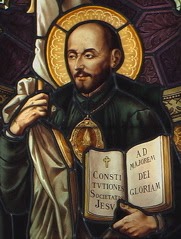
It was the founder of the Jesuits, St. Ignatius of Loyola, who coined the phrase Sentire Cum Ecclesia (To think with the Church).  In one section of his Spiritual Exercises, St. Ignatius describes the proper attitude that the believer should have toward the teachings and practices of the Roman Catholic Church.  I take the time to illustrate a quote from Rules for Thinking with the Church from these Spiritual Exercises:
That we may be altogether of the same mind and in conformity with the Church herself, if she shall have defined anything to be black which to our eyes appears to be white, we ought in like manner to pronounce it to be black. For we must undoubtedly believe, that the Spirit of our Lord Jesus Christ, and the Spirit of the Orthodox Church His Spouse, by which Spirit we are governed and directed to Salvation, is the same. (Thirteenth Rule)
I bring this up because I have all too often seen in our Church times where various people have taken a position opposed to an official Church teaching (regarding faith and morals) and justified it by saying that they are following their conscience.  It is absolutely true that we must always follow our conscience, but it is also true that we must do what is in our power to be sure that our consciences are rightly formed.  For Catholics, this includes our awareness of and ascent to the teaching authority (magisterium) of the Catholic Church.
I look at it this way.  The Catholic Church has been around a lot longer than I have been.  Its collective wisdom and teaching from over 2000 years is more than my finite mind and limited intelligence could ever grasp.  
I believe the Church was established by Jesus Christ and that He is still with it to guide it and protect it.  And behold, I am with you always, until the end of the age.”  (Mk. 28:20)  His Holy Spirit remains with and guides the Church. “. . . (Jesus) breathed on (the disciples) and said to them, ‘Receive the holy Spirit.’” (Jn. 20:22)
Just because “I” may not grasp something or see the reason for some teaching at some particular point in my life, I humbly bow to the authority of the Church while I continue to pursue a deeper understanding of the matter.  God gave us a mind (and intelligence) to ask questions and to pursue knowledge—and we should use it.  But I am (hopefully) wise enough to know that as a mere individual I may not always be right and I need the guidance of the Church to keep me on the right path.
It is true that individual members of the Church—even including members of the hierarchy—may not always live up to the official teachings of the Church.  This never means, however, that the doctrine or moral guidance of the Church becomes invalid or less necessary for our salvation.
The times we live in are tough enough and there are so many forces that try to trivialize, mock, and undermine the Church and its teaching authority.  I take consolation, however, in knowing that Jesus Christ has conquered sin and death and that He remains with His Church. 
It is my decision to stay with that Church as well.
Fr. Ed Namiotka
Pastor

St. Ignatius of Loyola