Monday, September 26, 2011

Sentire Cum Ecclesia


Dear Parishioners,
It was the founder of the Jesuits, St. Ignatius of Loyola, who coined the phrase Sentire Cum Ecclesia (To think with the Church).  In one section of his Spiritual Exercises, St. Ignatius describes the proper attitude that the believer should have toward the teachings and practices of the Roman Catholic Church.  I take the time to illustrate a quote from Rules for Thinking with the Church from these Spiritual Exercises:
That we may be altogether of the same mind and in conformity with the Church herself, if she shall have defined anything to be black which to our eyes appears to be white, we ought in like manner to pronounce it to be black. For we must undoubtedly believe, that the Spirit of our Lord Jesus Christ, and the Spirit of the Orthodox Church His Spouse, by which Spirit we are governed and directed to Salvation, is the same. (Thirteenth Rule)
I bring this up because I have all too often seen in our Church times where various people have taken a position opposed to an official Church teaching (regarding faith and morals) and justified it by saying that they are following their conscience.  It is absolutely true that we must always follow our conscience, but it is also true that we must do what is in our power to be sure that our consciences are rightly formed.  For Catholics, this includes our awareness of and ascent to the teaching authority (magisterium) of the Catholic Church.
I look at it this way.  The Catholic Church has been around a lot longer than I have been.  Its collective wisdom and teaching from over 2000 years is more than my finite mind and limited intelligence could ever grasp.  
I believe the Church was established by Jesus Christ and that He is still with it to guide it and protect it.  And behold, I am with you always, until the end of the age.”  (Mk. 28:20)  His Holy Spirit remains with and guides the Church. “. . . (Jesus) breathed on (the disciples) and said to them, ‘Receive the holy Spirit.’” (Jn. 20:22)
Just because “I” may not grasp something or see the reason for some teaching at some particular point in my life, I humbly bow to the authority of the Church while I continue to pursue a deeper understanding of the matter.  God gave us a mind (and intelligence) to ask questions and to pursue knowledge—and we should use it.  But I am (hopefully) wise enough to know that as a mere individual I may not always be right and I need the guidance of the Church to keep me on the right path.
It is true that individual members of the Church—even including members of the hierarchy—may not always live up to the official teachings of the Church.  This never means, however, that the doctrine or moral guidance of the Church becomes invalid or less necessary for our salvation.
The times we live in are tough enough and there are so many forces that try to trivialize, mock, and undermine the Church and its teaching authority.  I take consolation, however, in knowing that Jesus Christ has conquered sin and death and that He remains with His Church. 
It is my decision to stay with that Church as well.
Fr. Ed Namiotka
Pastor
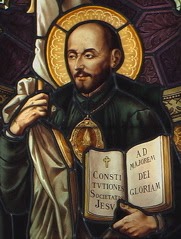
St. Ignatius of Loyola

Tuesday, September 20, 2011

Look Me in the Eyes


Dear Parishioners,
This past year, a popular movie, The Social Network, told the story of the origin and growth of Facebook.  For those familiar with Facebook no explanation is needed but for the technosaurs among us Facebook is a social networking service and website launched in February 2004.  Users create a personal profile, add other users as friends, and exchange messages, including automatic notifications when they update their profile.  As of July 2011[update], Facebook had more than 750 million active users worldwide.

Let’s face it, today people communicate in all-too-many and varied ways.  Cell phones and now smart phones are more common than ever before.  Text messaging, various forms of instant messaging (IM), blogging and microblogging (such as Blogger and Twitter) are ever-more-popular ways of rapidly and extensively communicating.  Paperless e-mail has replaced snail mail (i.e., mail delivered by the post office) for many people.  YouTube allows us to put our videos online and to broadcast ourselves worldwide.  As a result, all too much time is spent in front of a computer, television screen or some form of monitor.
And what exactly is the result of all of this communicating via technology?  In my humble opinion, it can be a loss of the personal touch and some basic social and interpersonal skills.
When I was the administrator of a high school, if a student would walk past me in the hallway (as if I didn’t exist) and not say anything to me, I would deliberately stop him or her, say “hello,” look him or her in the eyes and inquire how he or she was.  To me, it was an opportunity to teach an important lesson:  each and every person is important, and deserves our respect and our attention.
I will be the first to admit that I use technology to help me to communicate.  I have a Facebook page, a blog (www.fr-ed-namiotka.com) and a Twitter account.  I have been able to connect with so many people worldwide that it is truly amazing to me.  
However, I hope that I never lose the personal touch when dealing with people.  I hope that I am not too busy or too preoccupied to extend a greeting or to shake a hand.  I hope that I never forget to smile at someone or to stop and listen to the person who may need a compassionate ear and some of my time.
I even realize that the entire sacramental system in the Catholic Church, based on the teaching of Jesus and His Church, involves an interpersonal experience of Jesus through various rituals and signs.  We encounter Jesus, His grace and His love so many times through the instrument of the priest.  “I absolve you . . . .”  “This is my Body.”  “I baptize you . . . .”  “Through this holy anointing . . . .”
Please use technology for good and noble purposes.  But also realize that nothing can substitute for the personal touch that only a human being can give.
“And the Word became flesh and made his dwelling among us . . . .” (John 1:14)  
Fortunately, He didn’t just send us a tweet.

Fr. Ed Namiotka
 Pastor

Tuesday, September 13, 2011

A Man’s House is His Castle


Dear Parishioners,
Sir Edward Coke, an English jurist, Member of Parliament, and writer is given credit for the following quotation:   "For a man's house is his castle, et domus sua cuique est tutissimum refugium [and each man's home is his safest refuge]."
Growing up as a child and teenager, I never actually lived in a family “house.”  My parents initially operated a grocery store and butcher shop in Philadelphia, and we lived above the store.  When they purchased a hotel in Wildwood in the early 1960’s, we inhabited two rooms during the summer months that were considered our “living quarters.”  During the various winters, we rented a modest bungalow and/or lived in an apartment building.  When we built our motel in 1977, we again had a small section of the building designated as “living quarters.” 
By eighteen years old, I was off to the seminary and occupied various dormitory rooms for the next eight years.  At one point I was even the top bunk (of two bunk beds) at Mt. St. Mary’s Seminary.  As a priest, the usual living arrangements are generally a suite of rooms:  bedroom, sitting room and bathroom.  (When I return home to see my mom, she lives in a two-bedroom condominium.)
So, technically speaking, I have never actually lived in a family “house.”
I guess that’s why I truly attempt to make the rectory where I live my “home,” no matter how long I am going to be there.  So if you see me painting, fixing, remodeling or cleaning the rectory, it’s because I consider it my home, my castle, so-to speak, and I take pride in it.
I do realize, however, that no matter where I live here on this earth it is only temporary and that my true home (and ultimate desire) is supposed to be heaven:
For we know that if our earthly dwelling, a tent, should be destroyed, we have a building from God, a dwelling not made with hands, eternal in heaven. “ (2 Cor. 5:1)
This being said, I try to be a good steward of the property entrusted to me and it is my personal philosophy that when I eventually leave a place, it should be in better condition than how I found it.
Having lived in and with various businesses almost all of my life, I am also of the strong opinion that the church offices should not be in the same building in which the priests reside.  To me, it provides for more peace of mind (and mental health) when there is the sanctity of a home (rectory) to return to each day.
Whether by circumstance or by design, I’m glad that this was already in place at St. Joseph's before I arrived.
You are certainly welcome to visit our castle at any time—just be aware of the drawbridge when it is up since the man-eating alligators in the moat are usually hungry!
Fr. Ed Namiotka
Pastor

Tuesday, September 6, 2011

Organized Chaos . . . (or Honk If You Love Jesus!)


Dear Parishioners,
I have observed our church and school parking lot extravaganza for a few weeks now and it certainly has been enlightening.  For some reason it reminded me, in certain instances, of watching an old Keystone Cops movie.
If any parking lines once existed for guidance, they are pretty much faded.  People parked just about wherever they wanted to—two and even three deep at times during the Sunday morning Masses.  Cars were completely blocked in—including mine on more than one occasion.  In front of the school, what looked like a conga line (of cars) was forming.  One, two, three, honk.  (How’s that Sr. Rose?)  People came late.  People left early.  It appeared pretty much to me like sheep without a shepherd—to use a biblical image!
Well it just so happens that I am in the shepherding business.  They don’t call me pastor for nothing.  (I actually think that this vocation is meant for saving souls, but I will try to apply my skills to saving parishioners in cars and parking lots as well.)
My solution:
Step one.  Start a novena to the patron saint of parking lots—whoever that may be.
"Mother Cabrini, Mother Cabrini, please find a spot for my little machiney." 
"Hail Mary, full of grace, help me find a parking space."  (This second chant seems a bit too irreverent for me.  I love the Blessed Mother too much to relegate her to parking duty.) 
Sr. Mary Martha’s blog suggests St. Boniface as the patron saint of parking spaces.

Step two.  Get some of my former students who are now engineers (preferably of the civil variety) to help me evaluate the situation.
Step three.  Paint new lines in bold colors and put up a few new signs for direction.
Step four.  Appoint a minister of the parking lots and get volunteers to help direct traffic.
Step five.  If all else fails seek out St. Jude—the patron saint of hopeless cases!
In the beginning, when God created the heavens and the earth—and the earth was without form or shape, with darkness over the abyss and a mighty wind sweeping over the waters . . . .” (Genesis 1:1-2)
I figure if God can create the entire universe out of chaos, then maybe, just maybe, he can help me with this slightly smaller problem.
Hopefully the sheep will cooperate.
Beep.  Beep.
Fr. Ed Namiotka
Frustrated Shepherd

Monday, August 29, 2011

Weathering the Storm


Dear Parishioners,

An interesting week just passed.  Maybe that is an understatement.  An earthquake, a hurricane . . . what’s next?  Forget that I even asked that question.

As I heard the information that was passed on to us regarding hurricane Irene, I wondered what I should do.  Certainly I prayed.  Lord, avert this storm . . . .  I listened to the governor’s messages and the recommendations (mandates) from state and local officials about evacuations.  I thought about the situation in which I was currently living:  one of the highest points in Somers Point, an apparently sturdy brick house (rectory), no old or dead trees nearby and, most important to me, a one-block proximity to a functioning hospital.

In the end, I made the decision to stay put.  The hurricane was supposed to be hundreds of miles long.  Where exactly would the safest place in southern New Jersey or the greater Delaware Valley be?  Can anyone except God really know the answer to that question?

No Masses were actually cancelled this weekend.  I resolved that if anyone showed up, we would have Mass for them.  The numbers attending were, for the most part, not large but various people came for each Mass.

Thank God the people in our area seemed to weather the storm fairly well.  There were power outages, some trees down, water in basements, and other minor damage—but all overwhelmingly survivable conditions.

At the time, I thought about the Scripture passage referring to the house built on solid rock:

Everyone who listens to these words of mine and acts on them will be like a wise man who built his house on rock.  The rain fell, the floods came, and the winds blew and buffeted the house.  But it did not collapse; it had been set solidly on rock.  (Mt. 7:  24-25)

The analogy was loud and clear.  A strong foundation is of utmost importance when facing earthquakes, storms, hurricanes and other acts of God.  But it is even more important for our life of faith.  Without a strong faith in God, the storms of life may, in fact, seem impossible or unbearable.  We could wind up desperate and crying out for help like Peter did when he found himself sinking in the water:   

But when (Peter) saw how [strong] the wind was he became frightened; and, beginning to sink, he cried out, “Lord, save me!”  Immediately Jesus stretched out his hand and caught him, and said to him, “O you of little faith, why did you doubt?”  (Mt. 14: 30-31)

I do not advocate taking risky chances or ever foolishly putting ourselves in harm’s way unnecessarily.  However, when those storms of life come and we are forced to face them—whether they are natural disasters, physical setbacks, sickness, death or any number of various spiritual trials—we can never go wrong seeking out the protection and assistance of the Lord Jesus. 

With Him we can weather any storm.

Fr. Ed Namiotka

Pastor  

Wednesday, August 24, 2011

An American Flag in a Catholic Church?


Dear Parishioners,
When I arrived at St. Joseph’s Parish this summer, I made the resolution to take things slowly, to implement any changes gradually and to do a lot of observing.
Sometimes, however, certain issues come my way and I am requested to make a decision as Pastor.
One such matter is the placement of the American (and Papal) flags in church.
I began by praying about the situation.  Then I tried to find out the history of the matter within the parish.  Next, I referred to the United States Conference of Catholic Bishops (USCCB) web site.  This is what I found there:

Surprisingly to many, there are no regulations of any kind governing the display of flags in Roman Catholic Churches. Neither the Code of Canon law, nor the liturgical books of the Roman rite comment on this practice. As a result, the question of whether and how to display the American flag in a Catholic Church is left up to the judgment of the diocesan bishop, who in turn often delegates this to the discretion of the pastor.

The origin of the display of the American flag in many parishes in the United States appears have its origins in the offering of prayers for those who served during the Second World War (1941-1945). At that time, many bishops and pastors provided a book of remembrance near the American flag, requesting prayers for loved ones – especially those serving their country in the armed forces – as a way of keeping before the attention of the faithful the needs of military families. This practice has since been confirmed in many places during the Korean, Viet Nam and Iraqi conflicts.

The Bishops' Committee on the Liturgy has in the past encouraged pastors not to place the flag within the sanctuary itself, in order to reserve that space for the altar, the ambo, the presidential chair and the tabernacle. Instead, the suggestion has been made that the American flag be placed outside the sanctuary, or in the vestibule of the Church together with a book of prayer requests. It remains, however, for the diocesan bishop to determine regulations in this matter.

In essence, my solution at this time is to allow the placement of the flags outside of the sanctuary of the Church.  While I certainly love my country and consider myself patriotic, I am first and foremost Roman Catholic and a priest.  I believe what the Catholic Church believes and I try to teach what she believes as accurately as possible (given my finite, limited human mind!).
I hope that everyone realizes that I will try to respect all points of view, but in the end I often have to make the decision that I think is the best one for the good of the parish.
May God watch over us as we continue to seek out His divine wisdom.

Fr. Ed Namiotka
Pastor

 Papal Flag

Sunday, July 31, 2011

Seeing Things with a New Set of Eyes


Dear Parishioners,
As a high school administrator for years, I would instruct my fellow administrators to enter the school building each day with a “new set of eyes.”  I would try to do this myself as part of a morning ritual.  I looked around the school and asked myself various questions.
What did I observe today?  Is there anything that I had become so familiar with that I almost overlooked it or took it for granted?  Who was there?  What were they doing?  What was my overall impression?  What did I see?
Today I went through my ritual at the three Sunday morning Masses at St. Joseph’s Church.
What did I observe today?
First, I noticed how friendly, warm and welcoming you, my new parishioners, were!  I thank you for the greetings, the smiles and the kind words.  I was really moved by one comment in particular:  Father, we are here waiting to love you.”  Wow!  Thanks for that! The feeling is certainly mutual!
Second, I noticed the beautiful music at each Mass.  I love music and I love to sing.  For those who are stoic and non-participatory—you’ll just have to get used to me!  Oh well.
Third, I noticed the air conditioning was back, thanks be to God!  It appeared not strong enough, in my opinion, but then again I was layered with vestments.  Was it just me?  Some people were, however, fanning themselves during Mass.
At the 8:15 AM Mass, since I was not the celebrant, I stood in the back of church and I watched far too many people leave Mass early—many right after receiving Holy Communion.  I know I surprised quite a few since I was standing there.  Some avoided looking directly at me.  (Mental note:  We’ll have to work on that.  For right now I am just going to mention it.)
Next, I had the opportunity to welcome and to bless some parishioners who were hosting a family reunion at the 10 AM Mass and to renew the vows of a couple who was celebrating their 60th wedding anniversary at the 11:45 AM Mass.  I’m glad to see that this is going to be an active parish!
I also noticed the decent number of young people at Mass.  To me this is a partial indication that there is hope and a future.  If we don’t reach the young, then our Church is going to be in some trouble in the days ahead!
I noted some other things, but for now I think that I’ve said enough.  This writing is looking too much like an all-too-familiar classroom observation and I certainly don’t want to be doing that again!
Let me just add that I am happy to be here and I certainly look forward to the days, months and years ahead.  I want to keep building on the wonderful foundation that Fr. Joe Wagenhoffer left me! 
Thanks Joe!  You, your associates and your predecessors established a beautiful parish family here.
Fr. Ed Namiotka
Pastor

Thursday, July 28, 2011

Gay "Marriage"


Dear Parishioners,
Back in high school when I was a teenager I began listening to the music of Elton John. He was a popular artist in the 70’s and still is today. It was sometime later in his life—after a failed marriage attempt with a woman—that he announced to the world that he is a “gay” male. He has since made it a point to openly admit his sexual preference for men and even to legalize his committed relationship with another man.
I bring this up because of the step that was taken by New York State recently in legalizing committed homosexual relationships. I purposely avoid using the word marriage as many might use because of the specific meaning given to Christian marriage by the Church.
A working definition of a Christian marriage that I have taught for many years is this:  Marriage is a covenant of love and life made by a man and a woman that is permanent, exclusive and open to the possibility of children.  For two baptized Christians, it is also a sacrament.
While I understand the need for friendship, companionship and love in everyone’s life—gay or straight, single or married, male or female, religious or lay—we have to look at the long-term implications of certain actions that might be included with these various relationships.
The genital expression of love has a specific purpose as ordained by the author of life—God Himself.  Genital acts have a twofold purpose which cannot be separated:  love-making and life-giving. The situation becomes problematic with artificial contraception, homosexual sexual acts, masturbation, etc. because all of these acts have a sterility attached to them—whether deliberately intended or not.  Sexual gratification is intended by the Creator to be pleasurable but not to be sterile.  It is expressed simply in the Hebrew Scriptures this way: “Be fertile and multiply.” (Gn. 1:28)
In philosophy classes we were taught to examine and analyze an object completely to determine its intended purpose. For example, if we examine an ordinary pencil, we can (and should) conclude that it is made as an object with its intended purpose being a tool for writing. Sure we can use the pencil to stir something, to point at something or even to poke someone’s eye out (ouch!), but its intended purpose is to enable us to write something.
This type of analytical process is applicable to our bodies and our genitalia. In a homosexual act, the genitalia are not used in the manner in which they were intended by the Creator—bluntly, the parts do not fit properly—and the final result, while perhaps pleasurable, is painfully sterile and empty.
Everyone needs love, healthy chaste relationships, as well as companionship and friendship throughout life. While I do not claim to know the reason for homosexual attraction—is a person born this way or does he/she become this way?—I must conclude that the homosexual genital expression of love is both painfully sterile and an empty act. The Church considers these actions disordered and sinful.
Pastorally, I always attempt to condemn the sin, not the sinner. I cannot control what anyone does in or out of the bedroom. God gave us an intellect and free-will to determine our actions. I can, however, preach the truth as revealed in Sacred Scripture and taught by the Magisterium of the Church and try to prevent people from getting seriously hurt by what they do. I have always concluded that God knows best in these situations even when our limited human minds fail to see all of the implications of our actions.
I want people to be genuinely happy and to have committed relationships in life. However, these relationships, to follow God’s design, must be chaste and life-giving. For all of us—including those with homosexual tendencies—following the Gospel will be a challenge, perhaps even a cross. 
But the Gospel of Jesus Christ is never sterile.  It always gives lifeeternal life.
Fr. Ed Namiotka
Pastor

Tuesday, July 12, 2011

Bling . . . Bling . . . It’s All About Me


Dear Parishioners,
I was sitting in the airport in Copenhagen, Denmark waiting for a return trip back to the USA.  In a situation like this, I usually do some people watching to kill some time.
One woman—I think that she was an American—wore a black t-shirt with bold silver lettering that struck my attention.  It read:   Bling . . . Bling . . . It’s All About Me.
Little things like this tend to get me thinking.  I see a homily here somewhere. 
Maybe it’s a blessing, sometimes it’s a cross, but my mind usually tries to find something scriptural to which I can relate things and learn some lesson for life.  At the time I thought of John the Baptist and the words that came out of his mouth in reference to Jesus:  He must increase; I must decrease."  (John 3:30)  Maybe I should put that on a t-shirt.
In our lives as Christians there has to be a certain dying to self.  All of the bling bling belongs to this world.  You can’t take it with you, as they say.  (Even if the bling bling is placed in the coffin as it sometimes is, it never quite seems to get to the next world.  If it did then the grave robbers of history would have no incentive!)
True happiness, at least as I understand it, comes from trying to care for the needs of others and concentrating less on me.  The enlarged and inflamed ego needs to shrink to be healthy and to function properly.  Jesus gave us examples of service for us to follow illustrated magnificently by the washing of His disciples’ feet followed by His total self-giving on the cross.
Ego and self-gratification can drive one’s life and lead to destructive self-absorption and ruin, if left unchecked.  I” want more, more, more.  I” have to be the center of attention—constantly.  I” need to get/take the credit for something.  I, I, I . . . me, me, me” tends to dominate the conversation.  It’s all about me.
Spiritual growth often occurs when the other person and his/her needs become more important than my own needs, wants and desires.  Doesn’t a good parent do this for his/her children?  Doesn’t a loving husband anticipate the needs of his wife, and vice versa?  Doesn’t the dedicated pastor show loving concern for his parishioners and want to serve their needs?  It is at times like these that Jesus is glorified by our imitation of His example of service.
The rector of my seminary used to tell us this in our preparation for priesthood:  “A lot of good can be done for the Lord as long as no one cares who gets the credit.”  It can’t be all about me as a disciple.
He must increase; I must decrease.
Fr. Ed Namiotka
Pastor

Sunday, July 3, 2011

Can Design Save the World?


Dear Parishioners,

I am in a cruise ship on the Baltic Sea.  It is 3:38 AM.  I am sharing a cabin with two long-time priest-friends whom I have known since college.  The accommodations—consisting of two small dormitory-like beds and a pull-out bed—take some getting used to especially when you are accustomed to significantly more privacy.  Personal space in the cabin is difficult to find.  (Shhh!  Don’t tell anyone but one of them snores, making unusual sounds that vary from whimper to chain saw!  They say I snore too but I’m never awake to experience the pleasure!  Fortunately, earplugs are a wonderful invention to prevent insomnia and torture via sound-waves.)

We just finished visiting Copenhagen, Denmark.  It was a city containing a mixture of old brick buildings of varying quality and character interspersed with stark, bold new architecture employing much metal and glass.

If New York City is sometimes remembered as a city of endless yellow taxis, Copenhagen is a land of bicycles.  There are bike paths everywhere and the population uses them.  There are public garages to house thousands of these gas-saving vehicles.

Also noticeable is the absence of objects religious.

Years ago when I visited Poland with one of the same priest-friends, we remarked how there was an object of devotion—a statue, a wood carving, a religious picture—in just about every home, in every yard, at every crossroad.  Myriads of churches reminded us of a Divine Presence all over the land and people were in them praying.  Priests and sisters were in abundance and visibly present in the streets.  This was in what was then a communist (supposedly, but never really atheistic) nation.  Over 90% of the population was Catholic.

Copenhagen and all of Denmark is less than 1% Catholic.  We were hard pressed to find a religious symbol anywhere.  We discovered only a few churches—very few.  Looking up some statistics we were informed that there were officially only 77 Catholic priests in the entire country.  It’s a very free, worldly society—notably secular.

We passed a downtown building with a large banner hanging from it which seemed to me to summarize what I was experiencing.  It read:  Can Design Save the World?  The Danes boast of various innovative architectural wonders and award-winning designs, but there was an obvious void in their modern masterpieces—attention to anything religious.  The architecture was pragmatic and sterile.  It was confined to serve man but failed to glorify God—the author of the human person. 

So much of old Europe looked upward to God and their buildings, culture and handiwork reflected this.  Great cathedrals and churches were generally the centerpiece of every city.   Attention to God now seemed to be missing here.  He wasn’t reflected in the culture or its surroundings.  If Jesus was known and professed here, it was a well-kept secret.

Copenhagen, your city was clean, friendly and interesting.  You have some remarkably talented people illustrating the creative intelligence and beauty of the human person. 

However, I have something very important to share with you—a life-lesson that we all need for eternal life:  it is Jesus who saves. 

God has a master-plan for us.  That’s His design.

Fr. Ed Namiotka

Pastor