Monday, December 29, 2025

The "Holy Family" and the "Mother of God"

The Holy Family of Jesus, Mary and Joseph
Dear Parishioners,
On the Sunday after Christmas, the Church celebrates the feast of the Holy Family of Jesus, Mary and Joseph. Family means a great deal to me. I have worked hard over the years to try to keep my family together, wherever and whenever it was possible. Spending time my brothers and sister and their families, especially around the holidays, continues to be a special gift to me. I realize that no family is perfect. We all have to deal with particular family issues and circumstances, varying problems and challenges, diverse personalities, etc. Yet, all of this is accompanied by multiple blessings.
Sometimes I think that certain people tend to idealize the Holy Family and forget the many difficulties and hardships that Jesus, Mary and Joseph had to endure. We read in the Sacred Scriptures that Mary was found with child before living with Joseph. He was initially going to divorce her quietly. (Mt. 1: 18-19) Then, there was no place for Jesus to be born in the lodgings of Bethlehem after Joseph and Mary (now in the final stage of her pregnancy) had travelled considerable distance. (Lk. 2: 4-7) As an infant, Jesus’ life was threatened by King Herod and His parents had to flee with Him to Egypt. (Mt. 2: 13-18) Joseph and Mary seemingly lost—could not immediately find—the boy Jesus during their pilgrimage to Jerusalem. (Lk. 2: 41-51) Mary later witnessed her only Son tortured and killed in front of her eyes. (Jn. 19: 25)
These were not quite the circumstances of a perfect, ideal life, were they? Through it all, Jesus, Mary and Joseph had each other and were bound together by mutual love and respect. They all greatly loved and trusted God, our Heavenly Father, and were obedient to His will as it was revealed and unfolded for them.
Today, problems within the family unit continue to exist—at a somewhat grand scale and pace. Various people question, with some even wanting to redefine, the traditional understanding of “family.” Family life as we once knew it in society seems to be eroding. I contend that we need to look at the Sacred Scriptures to see what they teach us (albeit ever so briefly) about the family life experienced by the Holy Family. Their obvious trust in God in difficult circumstances, their obedience to His will, and their fidelity to God and to one another are great examples for us all to follow.
In addition, on January 1st the Catholic Church celebrates the Solemnity of the Blessed Virgin Mary, the Mother of God. While Catholics may use the term Mother of God regularly when praying the Hail Mary, some people may have questions about the meaning of this particular title. The Council of Ephesus (431) declared that the Blessed Virgin Mary is Theotokos or God-Bearer (in Greek). In the Latin Church, we use the term Mater Dei. Simply stated, our Catholic belief teaches that:
Although Mary is the Mother of God, she is not his mother in the sense that she is older than God or the source of her Son’s divinity, for she is neither. Rather, we say that she is the Mother of God in the sense that she carried in her womb a divine person—Jesus Christ, God "in the flesh" (2 John 7, cf. John 1:14)—and in the sense that she contributed the genetic matter to the human form God took in Jesus Christ. (Catholic Answers)
We should remember that the Blessed Virgin Mary is solely responsible for the genetic material for Jesus’ human body (in cooperation, of course, with the Holy Spirit) as St. Joseph was Jesus’ foster-father.
As we begin the New Year, I customarily entrust and consecrate my parish family (wherever I am pastor) to the care of the Blessed Virgin Mary on New Year’s Day. I give this parish and all of its parishioners over to the loving care of the Mother of God. I invite you to join me. I can think of no better way to begin the New Year.
God’s blessings in the New Year!
Fr. Ed Namiotka
Pastor
Thursday, December 25, 2025
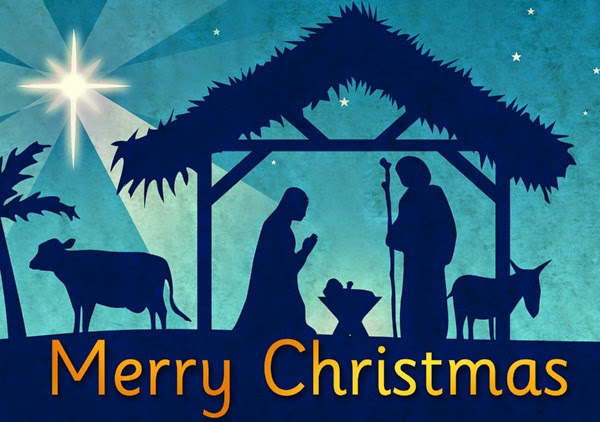
Have a Merry Christmas and a Blessed New Year!
Dear
Parishioners,
Is it my imagination or does every year seems to go by faster and faster? As I get older, I wish that things would slow down a little! In my opinion, there seems to be a constant push to move on to the next thing without necessarily taking the time to appreciate the present. Enjoy the Christmas season!
In
the Church, the celebration of Christmas lasts for eight days. The
joy of this wonderful solemnity is too great to contain within a single
day! We refer to this time as the Octave of Christmas. Most
people not familiar with the liturgical calendar would probably be surprised to
find out that the Christmas season actually extends to January
11, 2026—the Baptism of the Lord.
Sadly, by then many will not be in the Christmas spirit any longer because of
how early the commercial Christmas preparations begin. By the time
Christmas arrives, people are ready to take down their decorations. The Christmas
music will disappear. Many people often seem exhausted from all of
the things that they feel pressured into buying or doing.
With
Christmas upon us, please try to keep Christ at the heart of the
celebration. Society may tell us that we need to shop and exchange gifts,
to cook, to clean the house, to party and to do other things. All of this
seems to add to increased tension and lack of peace in peoples’ lives. Our
faith tells us to pray and to ready our hearts for Christ. This spiritual
preparation can bring us peace, happiness and joy that the world cannot
give. What type of Christmas do we want to have? The choice is always
ours to make.
This
Christmas, I ask that you pray for a stronger faith in Jesus
Christ, the Incarnate Son of God. As we get to know Him and fall
more deeply in love with Him, we can begin to realize how He is truly here for
us when everyone and everything else fails. He
gives meaning and purpose to our lives. He gives
us hope. He embodies love. He is love.
Our Christian faith involves an intimate, personal relationship that
God desires for us to have with Him. The celebration of
Christmas is truly about Jesus and His tremendous,
self-giving love for us. Christmas is all about love—Love that becomes Incarnate!
I
thank all who work so hard in the parish and continue to strengthen our
Christian community. Please be aware of how much we depend on you for your
prayers, your volunteering and service and your financial support. Christianity
is not like a “spectator sport” where we simply watch and cheer from a
distance. Rather, it truly involves active participation and
a life commitment: prayer, attendance at weekly Mass, a sacramental
life, Christian service, love of neighbor, etc. Our parish family will be
only as strong and vibrant as the people who faithfully participate
in it each week.
Be
assured that all members of St. Thomas More parish are remembered in my daily prayers and
Masses. May I ask a small remembrance in your prayers and Masses as
well?
Have a blessed and
peace-filled Christmas!
Fr. Ed Namiotka
Pastor
Monday, December 22, 2025
Monday, December 15, 2025
Tuesday, December 9, 2025
Eucharistic Adoration

Dear Parishioners,
The popular Christmas
Carol O Come All Ye Faithful (Adeste Fidelis) reminds
us to come and adore the Lord Jesus. Commonly, Christians
gather around the Nativity scene, crèche or manger at Christmas
to adore the Christ Child. Saint Francis of Assisi is credited
with creating the first nativity scene in 1223 (a living one) intending to cultivate the worship of Christ. The
scene's popularity eventually inspired communities to create ever more
elaborate static exhibitions with wax and ivory figurines garbed in rich
fabrics set against intricate landscapes.
While we may gather around statues or figures reminding us of the Christ Child and His birth into our world, I think that it is even more essential to recognize His Real Presence found in the Most Blessed Sacrament. It is so important that we come and adore Him who is truly present on our altars and in our tabernacles.
Many years ago, when I was in still in the college seminary, I
came across an article written by Archbishop Fulton Sheen relating
how he used to make a Eucharistic Holy Hour (before the
Blessed Sacrament) every day of his life. He said that while he was
praying before the Blessed Sacrament he felt he was being transformed like
Moses was when he prayed to God on Mt. Sinai:
As Moses came down from Mount Sinai with the two tablets of the
commandments in his hands, he did not know that the skin of his face had become
radiant while he conversed with the LORD. When Aaron, then, and the other
Israelites saw Moses and noticed how radiant the skin of his face had become,
they were afraid to come near him. (Exodus 34:29-30)
When we come into the Lord’s presence, Jesus can do
something to us. We may
think that we go to pray,
to petition and to worship, or even that we are doing God a favor by spending some
of our precious time with
Him. Our Lord Jesus, however, can transform us while we spend time with Him. We do not need to worry
about what prayers we should say, what spiritual readings we should be reading
or what we should be doing in His Presence. Just being with the Lord can be
transforming. He can soften our hearts, heal our wounds, inspire us and
guide us. He can give us an inner peace that nothing in this world can match. Making
the commitment to spend time with Him can truly transform us.
So why not think about spending some time with Him weekly? You
are invited to come and adore the Lord. Each weekday, after
the morning Mass at 9 AM, the Blessed Sacrament is exposed for adoration until
12 noon. Even if there is no formal exposition, the chapel is usually available
for prayer before the Blessed Sacrament whenever the church office is open. Perhaps
you could come a little earlier before Mass and devote some time in the church
or chapel before His Eucharistic presence, even on the weekends. I can
guarantee that if we spend time with Jesus in the Blessed Sacrament, your life
will mysteriously change for the better.
St. Carlo Acutis, the fifteen year old boy who promoted devotion
to the Holy Eucharist through the use of the internet is quoted as saying, “When we face the sun we get a tan… but
when we stand before Jesus in the Eucharist we become saints.”
You are invited to spend time with the
Lord in the Blessed Sacrament. What will your R.S.V.P. be?
Fr. Ed
Namiotka
Pastor
Sunday, December 7, 2025
Tuesday, December 2, 2025
The Call to Repentance

St. John the Baptist
Dear
Parishioners,
During
the second Sunday of Advent each year, St. John the Baptist is featured in the
gospel reading. His call is to repentance
and to be baptized as an outward sign of one’s turning away from sin. He is an
austere figure who lived in the desert and attracted many from the surrounding
region to hear his message of repentance.
The
Church gives us this figure during Advent to encourage all of us to prepare for
the coming of the Messiah, who we proclaim is Jesus of Nazareth, by repenting of our sins and a by conversion of
the way we live our lives—from sin to righteousness.
From
a Catholic perspective, the Sacrament of
Penance and Reconciliation (Confession)
is the best way to accomplish this today. All of the sacraments impart to us Grace, which is the supernatural help
that God gives us by an intimate experience of His Divine Presence. Jesus
interacts with us in every sacrament and raises us beyond the ordinary with His
Divine help.
Fortunately,
since I have been at St. Thomas More Parish over the past five years, I have witnessed more people
availing themselves of this sacrament on a regular basis. I certainly promote
this practice. When I was growing up, the religious sisters who taught me
encouraged monthly confession. We were told to examine our consciences each
night before we went to bed and then say an act of contrition. Moreover, we
were urged to get into the habit of monthly confession and to be sure to go as
soon as possible if there was any serious (mortal) sin in our lives. Confession
is required before receiving Holy Communion, if mortal sin is involved.
Some
day we will come before the judgment seat of Christ (see 2 Cor. 5:10) and will
have to account for all we have done, good and bad. We will then see things as
God sees them and will better comprehend the impact of our actions on others.
Each time we take advantage of the sacrament of confession, we prepare for that
Day of Judgment and are given the opportunity to repent now, to receive God’s forgiveness and to begin anew. It is the
confession of our sins to Christ, through the instrument of the priest, who
then gives us absolution in the name of Jesus Himself. The basis of this belief
is Jesus’ own words to his apostles on Easter Sunday night:
On
the evening of that first day of the week, when the doors were locked, where
the disciples were, for fear of the Jews, Jesus came and stood in their
midst and said to them, “Peace be with you.” When he had
said this, he showed them his hands and his side. The disciples rejoiced when
they saw the Lord. [Jesus] said to them again, “Peace
be with you. As the Father has sent me, so I send you.”
And when he had said this, he breathed on them and said to them, “Receive the
holy Spirit. Whose sins you forgive are forgiven them, and
whose sins you retain are retained.” (Jn. 20: 19-23)
So
when you hear me urge everyone to make a sacramental
confession during Advent, and to get into the habit of monthly confession, just
think of me as continuing the work of St. John the Baptist today.
As
long as there is sin, there will always be a call to repentance and conversion.
Fr.
Ed Namiotka
Pastor
Monday, December 1, 2025
Subscribe to:
Posts (Atom)